I'm currently working on Marion Nestle's book What to Eat, and just got done reading the section about fish. Despite the fact that fish are incredibly healthy for you (remember Michael Pollan's rule of thumb: The Less Legs, The Better?), there are some serious problems in the fishing industry that are often overlooked.
First, there's the obvious issue of overfishing. There are many species of fish that are being caught faster than they can reproduce, thus diminishing their numbers at a rapid pace. Popular fish like salmon, cod, and tuna; and delicacies like shark and octopus create a high demand...higher than what the Earth can sustain, and so their numbers are dwindling. Overfishing.org reports that 90 percent of large predatory fish are gone from the ocean.
One way the fish industry is addressing this problem is fish farming, which, while helpful when done appropriately, comes with its own set of issues, most notably fish feed. Carnivorous fish, like salmon, require pounds upon pounds of feeder fish for every pound of farmed fish, thus requiring even more fishing and ocean depletion. What's worse, is that many fish that don't typically eat much fish are being fed fish-based feed rather than a vegetarian feed. Further, fish from fish farms are sometimes genetically modified to allow for production in areas that wouldn't normally support this type of fish. When these farms are in open water systems (and they often are), these genetically modified fish can sometimes escape and then breed with wild fish. These "super fish" can also enter ecosystems that wouldn't normally sustain their breed, ultimately decimating feeder fish populations and starving larger predatory fish. Farmed fish are also frequently treated with antibiotics, and some fish (such as salmon) do not have the proper color because of the difference in diet, so the color is added artificially. Despite these issues, fish farming has its merits and can be a good alternative to overfishing when done right, and there are several certification programs to assess farming practices (the ASC just started certifying farmed tilapia; however, no other certification program has been officially approved by the US government).
Another big issue is methylmercury. Inorganic mercury has been released into the environment in rather large quantities, thanks in a large part to the burning of fossil fuels, but also to volcanoes, forest fires, etc. This mercury then makes its way to water systems, where it is converted to methylmercury. Methylmercury is then absorbed by oceanic wildlife and increases in concentration as you go up the food chain. As such, larger, carnivorous fish like shark and swordfish contain extremely high doses of mercury, which can cause a whole host of health problems, such as neurological damage, cardiovascular problems, and autoimmune disorders. These problems are particularly relevant for children and fetuses, who can show effects from much smaller doses.
PCBs are also a huge problem. Many of the Earth's watered are severely contaminated with PCBs originating from coolant fluids, plasticizers, paints, and a whole host of other things. Again, fish are contaminated with them and then the concentration grows and you climb the food chain. PCBs cause problems like skin conditions, liver damage, and cancer, and those issues are amplified in children, breastfeeding infants, and fetuses.
Clearly, there are serious issues with the fishing industry. What's worse, is that there is very little regulation in place to address them, and just as little done to identify problematic fishing practices to consumers. Country-of-origin labeling (COOL) went into effect in 2005 for all wild-caught fish, farmed fish, and shellfish (with exceptions for all "processed" fish). COOL is one way to determine the safety of fish, based on the water contamination in that country. Fish are also labeled as either "wild-caught" or "farmed," giving consumers another clue in their fish puzzle. Despite these labeling requirements, the labels are often incorrect, and even when they are correct, a consumer must be incredibly knowledgeable to be able to discern any meaning from these labels.
Some grocery stores, such as Whole Foods, label their fish using guides such as the Monterrey Bay Aquarium Seafood Watch or the Blue Ocean Institute Seafood Guide, which provide easy-to-understand ratings, such as "Best Choice," "Good Alternative," or "Avoid" for each type of fish they sell. Even more impressive, Whole Foods just announced that they will no longer sell wild-caught seafood with a Red/Avoid rating. And for those stores that don't display such informative labeling, these guides are also available as smartphone apps (which can also be used in restaurants, where labeling is not required). In spite of these efforts, the fishing industry has fought back ferociously. Many fisheries are disputing the credibility of these guides, rather than making an effort to change their practices.
In an effort to be more conscientious of my fish choices, I downloaded the MBA Seafood Guide app. Probably my biggest problem area so far has been sushi. Because I love spicy sushi and almost every spicy sushi roll has either tuna or salmon in it. Also, sushi restaurants don't typically include COOL (which makes it more difficult to determine the rating), so I would have to ask, and as I've mentioned before, I'm a wimp when it comes to asking about my food. But I went out for sushi the other day and got some spicy crawfish, that was super delicious.
I also bought some farmed Mediterranean Seabass today on the recommendation of another customer at Whole Foods. I didn't check the rating until after I'd purchased it, so it wasn't the best fish I could have picked, but not the worst either, at least. To add to my stupidity, here was my conversation with the guy behind the fish counter:
Me: "Could I get one of the smaller seabass? And could you skin it for me?"
Fish Guy: "...Skin it?"
Me: "Yeah. Skin it."
Fish Guy: "Do you mean 'scale' it? You want to keep the skin on, don't you?"
Me: "...Yeah. Well... you know what I mean."
So my snarky, know-it-all fish guy 'scaled' the fish for me and then offered to take the guts out as well. So I took my fish home and a few hours later, I opened up the package to find a fish that looked pretty much identical to the fish I saw in the display, except for the giant gash in the belly, where he probably took the guts out. It still had skin (although there weren't any scales to speak of). It still had bones. It still had fins. It still had a head.
This was a problem.
I wasn't feeling particularly well today and seriously considered putting the fish back in the fridge and dealing with it later, but I mustered up the energy to figure out what the heck to do with this fish in order to turn it into something I knew how to cook.
I figured it couldn't be that different from deboning a chicken, and I feel like I've seen someone just grab the head and pull all the bones out in one fell swoop, but I couldn't figure it out. So I ended up cutting the belly open all the way down to the back fin, where I managed to sort of lift out the bottom half of the spine... until it broke. Then I cut down either side of the remaining spine and just pulled it out. Then I had to go back for the little bitty rib bones or whatever you call them and pull them out individually with my fingers. Then I cut off the head and tail and fins and voilà! Two slightly ugly but totally cookable fish fillets! For reference, this seems like a much better way of doing it.
I put the fillets in an aluminum foil pouch, along with some butter, "minced" garlic, sea salt, and pepper. I also added some asparagus that I wrapped in bacon, and then sealed up the pouches. Then I cooked them at 400°F for about 20 minutes. And they were delicious! Since I wasn't feeling up to par, I didn't document the experience, but I'll likely do it again soon (preferably with a better fish) and I'll snap some pictures then. Hopefully I'll have perfected my fish deboning skills so you will all be impressed with my handy work... but that's pretty unlikely.
Showing posts with label Michael Pollan. Show all posts
Showing posts with label Michael Pollan. Show all posts
Sunday, April 8, 2012

Wednesday, October 12, 2011
The cost of a meal
I recently read this article about the cost of cooking versus the cost of fast food. The current idea is that cooking costs less than fast food, but in actuality those numbers only take into account the price of labor when it is outsourced (e.g., fast food). When you factor in the potential labor costs for cooking at home, the price more than triples and makes the convenience of fast food seem worth the extra couple bucks.
I have mixed feelings about the idea of introducing the labor costs to home-cooked meals. First off, unless you are a chef, you don't get paid to cook. Secondly, unless you'd otherwise be working every waking minute, you won't be out a portion of your paycheck either. On the other hand, many people do find cooking to be a lot of effort and not a lot of fun, so it may sort of seem like working without getting paid, so it is something to consider.
To that end, the author proposes we place a greater emphasis on the joys of cooking, and I couldn't agree more. I love being able to provide a gift so intimate as nourishment to my friends and family and being able to share that sense of community with them. I also like having total control over the things I put in my body, and I sleep easily knowing so much more about what I ate and where it came from. I like trying new things and seeing if I can make my food even better through little tweaks here and there, and I absolutely love the sense of accomplishment I feel when I've pulled off a truly successful meal. Not enough people know these joys, and it's such a shame.
The problem is, as Michael Pollan also pointed out, nobody really knows how to cook anymore. Who is going to teach us the joys of cooking if no one can cook? Sure, some people know how to cook, but upper-middle-class white people have a bit of an edge over inner-city African-Americans, in that they don't live in food deserts and can afford to take a class or two if they're so inclined.
The author suggested that the public school system take on the task, to which I scoff and say, "Good luck with that!" With the egregious budget cuts the entire education system is taking, there's no way anyone's gonna convince schools to re-instate home economics classes. I was lucky enough to take two sessions of home economics while in middle school and I can tell you right now I learned little to nothing about cooking and barely any more about sewing. This from a predominantly white mid-size town with excellent facilities (5-6 full kitchen work stations and about 30 sewing machines).
While I think utilizing the school system has the potential to be highly effective if done right (with a focus on money management and food preparation), I don't think this is feasible unless we find a magic money tree somewhere. Instead, we need to focus on what we can do and what we can teach. Everyone knows how to cook something, even if it's just a grilled cheese sandwich. Start there. Teach your kids how to make the best grilled cheese sandwich there ever was. Then send them to their aunt or their neighbor or their church to learn something new. Provide opportunities to learn whenever possible and try to learn with them. Help them to associate cooking with their sense of community and to take pride in their endeavors.
On the other side of this, we need to make infrastructure changes to eliminate food deserts and make healthy foods an affordable alternative through subsidies and education.
But a lot of these ideas are long-term goals. What can we do right now to make dining in more affordable? My answer: Cook in bulk. Last Tuesday I made about 12 servings of lasagna and 7 servings of pancakes and put most of them in the freezer. Sure, it was a lot of work on Tuesday, but over a week later I have severely cut down my cooking time and I have something I can grab'n'go when I'm rushing between work and school. If your freezer is big enough, cook a few different things all at once so you have options instead of eating lasagna every day (not that I'm complaining!). Cooking 12 servings of lasagna instead of 2 servings probably took an extra 10 minutes and I got an extra 10 meals out of the work. Same goes for the pancakes: A double batch will take 10 extra minutes but will double your servings at the end. Furthermore, it will save money in addition to time because you can buy food in bulk instead of buying single-serving containers.
Tada! Look at me try and solve the world's problems like I think they're easy. Or at least hand out a couple crutches to get by on.
I have mixed feelings about the idea of introducing the labor costs to home-cooked meals. First off, unless you are a chef, you don't get paid to cook. Secondly, unless you'd otherwise be working every waking minute, you won't be out a portion of your paycheck either. On the other hand, many people do find cooking to be a lot of effort and not a lot of fun, so it may sort of seem like working without getting paid, so it is something to consider.
To that end, the author proposes we place a greater emphasis on the joys of cooking, and I couldn't agree more. I love being able to provide a gift so intimate as nourishment to my friends and family and being able to share that sense of community with them. I also like having total control over the things I put in my body, and I sleep easily knowing so much more about what I ate and where it came from. I like trying new things and seeing if I can make my food even better through little tweaks here and there, and I absolutely love the sense of accomplishment I feel when I've pulled off a truly successful meal. Not enough people know these joys, and it's such a shame.
The problem is, as Michael Pollan also pointed out, nobody really knows how to cook anymore. Who is going to teach us the joys of cooking if no one can cook? Sure, some people know how to cook, but upper-middle-class white people have a bit of an edge over inner-city African-Americans, in that they don't live in food deserts and can afford to take a class or two if they're so inclined.
The author suggested that the public school system take on the task, to which I scoff and say, "Good luck with that!" With the egregious budget cuts the entire education system is taking, there's no way anyone's gonna convince schools to re-instate home economics classes. I was lucky enough to take two sessions of home economics while in middle school and I can tell you right now I learned little to nothing about cooking and barely any more about sewing. This from a predominantly white mid-size town with excellent facilities (5-6 full kitchen work stations and about 30 sewing machines).
While I think utilizing the school system has the potential to be highly effective if done right (with a focus on money management and food preparation), I don't think this is feasible unless we find a magic money tree somewhere. Instead, we need to focus on what we can do and what we can teach. Everyone knows how to cook something, even if it's just a grilled cheese sandwich. Start there. Teach your kids how to make the best grilled cheese sandwich there ever was. Then send them to their aunt or their neighbor or their church to learn something new. Provide opportunities to learn whenever possible and try to learn with them. Help them to associate cooking with their sense of community and to take pride in their endeavors.
On the other side of this, we need to make infrastructure changes to eliminate food deserts and make healthy foods an affordable alternative through subsidies and education.
But a lot of these ideas are long-term goals. What can we do right now to make dining in more affordable? My answer: Cook in bulk. Last Tuesday I made about 12 servings of lasagna and 7 servings of pancakes and put most of them in the freezer. Sure, it was a lot of work on Tuesday, but over a week later I have severely cut down my cooking time and I have something I can grab'n'go when I'm rushing between work and school. If your freezer is big enough, cook a few different things all at once so you have options instead of eating lasagna every day (not that I'm complaining!). Cooking 12 servings of lasagna instead of 2 servings probably took an extra 10 minutes and I got an extra 10 meals out of the work. Same goes for the pancakes: A double batch will take 10 extra minutes but will double your servings at the end. Furthermore, it will save money in addition to time because you can buy food in bulk instead of buying single-serving containers.
Tada! Look at me try and solve the world's problems like I think they're easy. Or at least hand out a couple crutches to get by on.
Friday, September 23, 2011
Food Politics
I finally finished reading "Food Politics" by Marion Nestle last month. I'm not gonna lie, it's kind of a tough read, but definitely worth it.
Basically, the whole point of the book is to bring attention to the fact that the FDA basically has no power and every time it tries to assert itself, it loses even more ground. Nestle discusses this from several different angles and also gives a rough time line of what the FDA has done (or been stopped from doing) over the last 40 or so years.
What was especially disparaging was the way food companies began being able to put "health claims" on their packaging and in their advertising, mostly thanks to the supplement industry. The supplement industry helped build a grassroots effort to allow consumers the "right to choose" what is best for them. After the passage of the Dietary Supplement Health and Education Act of 1994 (DSHEA), the supplement industry was allowed to put health claims on their products, even if those claims had little or no scientific evidence to back them up. Following this was the creation of functional foods, the sole purpose of which is to act as a "healthier" alternative to traditional food. Companies marketing functional foods made the claim that these foods had added supplements and under DSHEA, they had the right to advertise the things that made them so "healthy."And so they did. And now everything in the supermarket seems to have one health claim or another on it.
Furthermore, the FDA seems to be blocked from every possible side. Nestle talked about her time working on the Surgeon General's Report on Nutrition and Health, and how she was explicitly told she would not be allowed to make any recommendations that would suggest that a person eat less of any particular food because the food industry would pull its financial support from the elected officials responsible for its release. As such, Nestle had to resort to attacking specific nutrients rather than types of food. Instead of telling people to eat less red meat, she had to say "Choose a diet low in saturated fat." These types of statements are confusing to consumers and allow other equally unhealthy foods to take advantage of advertising their low-fat status (even though they are full of sugar or high fructose corn syrup). Even more interestingly, the FDA has no control over what gets put in advertising that is not on the package, because that has to go through the FCC.
What's worse is that the FDA has 120 days from when a food company petitions to put a health claim on its product to determine if the claim is accurate and must prove it is inaccurate within that time frame in order to prohibit its use. If the 120 days expires, the claim is automatically approved. And should the FDA later determine the product is unsafe, the FDA can't actually do anything about it. They can only "request" that a food company recall the product. As you can imagine, the FDA is totally underfunded for such a task and so most of these petitions go through without so much as an eyelash batted at them.
Nestle's book is very technical, so it's a slow read. But the information is invaluable and really makes me think carefully about the health claims I hear, where I hear them, and who is paying for them. As Michael Pollan said, if a food makes a health claim, it probably isn't real food. Words to live by right there.
In other book news, I'm currently working on "The Story of Sushi" by Trevor Corson, which is mostly a bookumentary on a group of aspiring sushi chefs. Most of it is sort of funny stories about their time at sushi school, but there are a lot of interesting bits about how sushi is made traditionally and how sushi has changed over time and since its arrival in the United States. I don't have much time for it now that school is started, but I'm slowly working my way through it. I also bought a fun book called "Insanewiches" by Adrian Fiorino, which is basically a picture/cook book of crazy sandwiches. Not all of them are healthy (Most notably the Quadruple Down, featuring four fried chicken breasts, bacon, cheese, mayo, etc. I'm having a heart attack just looking at the picture), but there are many that are at least reasonably good for you. And they're cute. So I will probably make some and post them on here at some point.
Basically, the whole point of the book is to bring attention to the fact that the FDA basically has no power and every time it tries to assert itself, it loses even more ground. Nestle discusses this from several different angles and also gives a rough time line of what the FDA has done (or been stopped from doing) over the last 40 or so years.
What was especially disparaging was the way food companies began being able to put "health claims" on their packaging and in their advertising, mostly thanks to the supplement industry. The supplement industry helped build a grassroots effort to allow consumers the "right to choose" what is best for them. After the passage of the Dietary Supplement Health and Education Act of 1994 (DSHEA), the supplement industry was allowed to put health claims on their products, even if those claims had little or no scientific evidence to back them up. Following this was the creation of functional foods, the sole purpose of which is to act as a "healthier" alternative to traditional food. Companies marketing functional foods made the claim that these foods had added supplements and under DSHEA, they had the right to advertise the things that made them so "healthy."And so they did. And now everything in the supermarket seems to have one health claim or another on it.
Furthermore, the FDA seems to be blocked from every possible side. Nestle talked about her time working on the Surgeon General's Report on Nutrition and Health, and how she was explicitly told she would not be allowed to make any recommendations that would suggest that a person eat less of any particular food because the food industry would pull its financial support from the elected officials responsible for its release. As such, Nestle had to resort to attacking specific nutrients rather than types of food. Instead of telling people to eat less red meat, she had to say "Choose a diet low in saturated fat." These types of statements are confusing to consumers and allow other equally unhealthy foods to take advantage of advertising their low-fat status (even though they are full of sugar or high fructose corn syrup). Even more interestingly, the FDA has no control over what gets put in advertising that is not on the package, because that has to go through the FCC.
What's worse is that the FDA has 120 days from when a food company petitions to put a health claim on its product to determine if the claim is accurate and must prove it is inaccurate within that time frame in order to prohibit its use. If the 120 days expires, the claim is automatically approved. And should the FDA later determine the product is unsafe, the FDA can't actually do anything about it. They can only "request" that a food company recall the product. As you can imagine, the FDA is totally underfunded for such a task and so most of these petitions go through without so much as an eyelash batted at them.
Nestle's book is very technical, so it's a slow read. But the information is invaluable and really makes me think carefully about the health claims I hear, where I hear them, and who is paying for them. As Michael Pollan said, if a food makes a health claim, it probably isn't real food. Words to live by right there.
In other book news, I'm currently working on "The Story of Sushi" by Trevor Corson, which is mostly a bookumentary on a group of aspiring sushi chefs. Most of it is sort of funny stories about their time at sushi school, but there are a lot of interesting bits about how sushi is made traditionally and how sushi has changed over time and since its arrival in the United States. I don't have much time for it now that school is started, but I'm slowly working my way through it. I also bought a fun book called "Insanewiches" by Adrian Fiorino, which is basically a picture/cook book of crazy sandwiches. Not all of them are healthy (Most notably the Quadruple Down, featuring four fried chicken breasts, bacon, cheese, mayo, etc. I'm having a heart attack just looking at the picture), but there are many that are at least reasonably good for you. And they're cute. So I will probably make some and post them on here at some point.
Thursday, May 26, 2011
TV Cooking/Home Cooking
A while back I found this really great Michael Pollan essay about cooking shows. It's pretty long, but basically he makes a point about how incredibly odd it is that people are cooking less and less, yet they are watching more and more food and cooking shows. Pollan suggests that this infatuation stems from a conflict between a general fear of cooking (e.g., the unknown) and a general love of food. Cooking shows allow people to become familiar with cooking from a safe distance and zero chance of failure. A great analogy Pollan gave was that cooking shows are like sporting matches: A lot of people watch them, but few actually do it themselves.
I never really understood cooking shows. When I was little, before the Internet was as far-reaching as it is today, I didn't know how people could possibly keep up with the likes of Martha Stewart and Paula Deen. Why would people watch these cooking shows if they can't make the food? Now, with the Internet, they can preview the show and pick out their favorite recipes online, so it makes a little more sense.
But then we get to cooking competition shows. I can't taste the foods they're making, so how do I know if it's any good?! This was the question I always asked with these shows. Other competition shows, like American Idol, Dancing with the Stars, and Project Runway have results that I can see and hear, so I know if the winner is actually good or not. And yes, presentation is important (and so I can get down with cake decorating and other art-based food competitions), but bottom line is that it can look horrible and actually be pretty tasty, or it can look beautiful and taste like plastic.
Last summer, a couple of my friends were really into Top Chef, so we got together each week to watch it and have dinner. I didn't really care that much about the show (Most of the good parts were the bits of "drama" between the contestants), but I liked that we'd each take turns cooking dinner and eating together before the show. Since then, our group shifted and merged into another group and now we do Movie Night instead. Each week we watch two movies that are related somehow and make a dinner that fits with the week's theme (i.e., The Hunt for Red October, Red Dawn, and Russian cuisine). It's pretty fun and forces us to get creative sometimes and try making new things, like syrniki.
However, Pollan fears that actual, legitimate cooking may be lost forever. With the far-reaching availability of pre-packaged, processed, and fully-cooked "food," who needs to cook anymore? Further, who even knows how to cook? Does heating up a can of soup or making a peanut butter and jelly sandwich count? It shouldn't, but it does.
Young adults like me learned very little about cooking from their parents. I can work my way around the kitchen, but I can guarantee you that I was offered nowhere near the same expertise from my mother that she had from her mother. My mom gave me a few favorite family recipes and showed me the basics for cooking, but most of what I cook now I learned from the Internet, cookbooks, other cooks, or from having the courage to try something new.
My husband is the same way, though he doesn't have quite as much enthusiasm for trying new things as I do. His father doesn't know how to cook anything more than making a sandwich or heating up leftovers in the microwave. I've often wondered what he ate for the ten years that he lived alone before he met his wife, but I'm too shy to ask. Or I'm afraid to hear the answer. But anyway, as a result of my father-in-law's complete and utter lack of cooking knowledge, my mother-in-law forced my husband and his brother to learn how to cook, though I think his little brother may have gotten off a little easier because I'm not sure I've actually seen him cook real food on his own, but I could be wrong.
So I guess we're two people that give a sliver of hope to future cooks, but I know way too many people that rely heavily on pre-packaged, processed food that requires little more than water and heat. The sad thing is that their kids won't know the difference because no one's mom or dad will actually cook from scratch. Hell, they might even think boxed cake mix is cooking from scratch, rather than just buying a pre-made one from the store. What's even worse is the stigma associated with cooking from scratch. It seems to be fading somewhat, but there was definitely a time in my life where it was kind of uncool to have your parents cook from scratch. When you had a birthday, you wanted Pizza Hut and store-bought cake for your party, not a homemade three-course meal with Grandma's red velvet cake. You wanted to go to McDonald's for dinner, not Mom's goulash. Homemade food seemed so...simple. If you could afford the luxury of already prepared food, why should you bother cooking? You could have your food now, instead of having to go to the trouble of making it over the next hour.
Pollan's advice is simple: Cook more. Eat whatever you want, as long as you cook it yourself. When you do, it's fresher, healthier, and hopefully tastier (though who knows what your cooking capabilities are). It's also cheaper and, if you shop wisely, better for your local economy and the environment. So that's what I'm trying to do. I'm not perfect, but I'm getting better.
I never really understood cooking shows. When I was little, before the Internet was as far-reaching as it is today, I didn't know how people could possibly keep up with the likes of Martha Stewart and Paula Deen. Why would people watch these cooking shows if they can't make the food? Now, with the Internet, they can preview the show and pick out their favorite recipes online, so it makes a little more sense.
But then we get to cooking competition shows. I can't taste the foods they're making, so how do I know if it's any good?! This was the question I always asked with these shows. Other competition shows, like American Idol, Dancing with the Stars, and Project Runway have results that I can see and hear, so I know if the winner is actually good or not. And yes, presentation is important (and so I can get down with cake decorating and other art-based food competitions), but bottom line is that it can look horrible and actually be pretty tasty, or it can look beautiful and taste like plastic.
Last summer, a couple of my friends were really into Top Chef, so we got together each week to watch it and have dinner. I didn't really care that much about the show (Most of the good parts were the bits of "drama" between the contestants), but I liked that we'd each take turns cooking dinner and eating together before the show. Since then, our group shifted and merged into another group and now we do Movie Night instead. Each week we watch two movies that are related somehow and make a dinner that fits with the week's theme (i.e., The Hunt for Red October, Red Dawn, and Russian cuisine). It's pretty fun and forces us to get creative sometimes and try making new things, like syrniki.
However, Pollan fears that actual, legitimate cooking may be lost forever. With the far-reaching availability of pre-packaged, processed, and fully-cooked "food," who needs to cook anymore? Further, who even knows how to cook? Does heating up a can of soup or making a peanut butter and jelly sandwich count? It shouldn't, but it does.
Young adults like me learned very little about cooking from their parents. I can work my way around the kitchen, but I can guarantee you that I was offered nowhere near the same expertise from my mother that she had from her mother. My mom gave me a few favorite family recipes and showed me the basics for cooking, but most of what I cook now I learned from the Internet, cookbooks, other cooks, or from having the courage to try something new.
My husband is the same way, though he doesn't have quite as much enthusiasm for trying new things as I do. His father doesn't know how to cook anything more than making a sandwich or heating up leftovers in the microwave. I've often wondered what he ate for the ten years that he lived alone before he met his wife, but I'm too shy to ask. Or I'm afraid to hear the answer. But anyway, as a result of my father-in-law's complete and utter lack of cooking knowledge, my mother-in-law forced my husband and his brother to learn how to cook, though I think his little brother may have gotten off a little easier because I'm not sure I've actually seen him cook real food on his own, but I could be wrong.
So I guess we're two people that give a sliver of hope to future cooks, but I know way too many people that rely heavily on pre-packaged, processed food that requires little more than water and heat. The sad thing is that their kids won't know the difference because no one's mom or dad will actually cook from scratch. Hell, they might even think boxed cake mix is cooking from scratch, rather than just buying a pre-made one from the store. What's even worse is the stigma associated with cooking from scratch. It seems to be fading somewhat, but there was definitely a time in my life where it was kind of uncool to have your parents cook from scratch. When you had a birthday, you wanted Pizza Hut and store-bought cake for your party, not a homemade three-course meal with Grandma's red velvet cake. You wanted to go to McDonald's for dinner, not Mom's goulash. Homemade food seemed so...simple. If you could afford the luxury of already prepared food, why should you bother cooking? You could have your food now, instead of having to go to the trouble of making it over the next hour.
Pollan's advice is simple: Cook more. Eat whatever you want, as long as you cook it yourself. When you do, it's fresher, healthier, and hopefully tastier (though who knows what your cooking capabilities are). It's also cheaper and, if you shop wisely, better for your local economy and the environment. So that's what I'm trying to do. I'm not perfect, but I'm getting better.
Monday, March 7, 2011
Animal, Vegetable, Miracle
I finally finished reading Barbara Kingsolver's book, Animal, Vegetable, Miracle this morning. I thoroughly enjoyed it and it brought to my attention a lot of food issues that I hadn't thought of before, but there was one thing that just didn't rub me the right way.
The premise of the book is that Kingsolver and her family decide to eat nothing but local food for an entire year, but they seem to break the rules every chance they get! They start off immediately breaking the rules by allowing for several exceptions right off the bat. They are allowed to eat grains and olive oil based on the simple fact that those things just aren't available locally. Okay, I said to myself, those are kind of necessities and if there's no way to get those locally, it's at least a step in the right direction. Then, on top of that, each family member got one "freebie" food: coffee, dried fruit, hot chocolate, and spices. Alright, I'll let that slide too. In fairness, they were buying those things from farmers who got fair wages and practiced sustainable agriculture, which is also important, and everyone needs a treat now and then.
But then they went on not one, but two multi-week vacations over the course of the year. And yes, they ate local foods from their vacation sites, sometimes, but not always. And they ate at friends' houses who didn't follow their locavore lifestyle and even ate out at restaurants that didn't serve local food on occasion.
Now don't get me wrong. Kingsolver and her family did a much better job of eating local, sustainable, and organic food than I do and probably better than I ever will. They grew a huge garden and raised their own animals and bought plenty of food from local farmers. And the vast majority of their food was local. But the thing here is that this was hardly a change for them. They already ate out of their garden previously and bought lots of food from the farmer's market and made an effort to eat local whenever possible. My point is, how is this any different than what they already did? They stepped it up a notch, but they really didn't go all the way, as the book promised in the beginning.
That being said, Kingsolver did an excellent job of making me appreciate and understand the importance of purchasing local food. I already knew it was important because you put money back into your local economy and it's fresher and all that. But one thing I never really thought about was all of the fossil fuels it takes to get food from all over the world to the grocery store. If we ate locally grown food instead, the fuel cost would be practically non-existent. Even doing something as simple as buying fruits and vegetables at the farmer's market instead of the grocery store would make a huge difference.
One other thing I really liked about the book was the inclusion of so many recipes they used to make locally produced breakfasts, lunches, and dinners. Once spring starts to roll around, I'll have to try to make some of these when the produce is in season.
I also appreciated the alternating format of the book. Most of the story is told through Kingsolver, but her older daughter, Camille, had an essay related to Kingsolver's story at the end of most chapters. And Kingsolver's husband, Steven Hopp, interjected with relevant facts and statistics throughout the narrative as well. The writing is charming, witty, and endearing. I could feel the happiness, worry, pride, and panic in Kingsolver's words, and her passion fueled my desire to eat better. I think the next book I'll work on is Marion Nestle's Food Politics. Michael Pollan referenced this one several times in his works, so it's likely awesome.
On that note, I went to the co-op grocery store today and picked up a few more local items than usual. After I went through nearly two dozen eggs last week, I snatched up a carton of my usual cage-free organic eggs. But just as I was about to walk away, I saw a row of plain egg cartons and all that was stamped on them was the name of the farm and the city where they farmed. My city. Without a second thought, I checked the local eggs for cracks and put back my usual eggs. I also found a brand of cottage cheese made on a farm only 20 miles from where I live, so I grabbed some to make lasagna this week. I also got another whole chicken from a local farm, and I bought bread baked at the co-op rather than baked elsewhere and then shipped to the co-op, so it saved a little gas there.
Also, one of my cooks at work read about my poached egg fiasco and gave me a little pep talk (re: made fun of me). So I watched him poach a couple eggs this weekend, and retried poaching eggs on Saturday afternoon. Here are my results:


The premise of the book is that Kingsolver and her family decide to eat nothing but local food for an entire year, but they seem to break the rules every chance they get! They start off immediately breaking the rules by allowing for several exceptions right off the bat. They are allowed to eat grains and olive oil based on the simple fact that those things just aren't available locally. Okay, I said to myself, those are kind of necessities and if there's no way to get those locally, it's at least a step in the right direction. Then, on top of that, each family member got one "freebie" food: coffee, dried fruit, hot chocolate, and spices. Alright, I'll let that slide too. In fairness, they were buying those things from farmers who got fair wages and practiced sustainable agriculture, which is also important, and everyone needs a treat now and then.
But then they went on not one, but two multi-week vacations over the course of the year. And yes, they ate local foods from their vacation sites, sometimes, but not always. And they ate at friends' houses who didn't follow their locavore lifestyle and even ate out at restaurants that didn't serve local food on occasion.
Now don't get me wrong. Kingsolver and her family did a much better job of eating local, sustainable, and organic food than I do and probably better than I ever will. They grew a huge garden and raised their own animals and bought plenty of food from local farmers. And the vast majority of their food was local. But the thing here is that this was hardly a change for them. They already ate out of their garden previously and bought lots of food from the farmer's market and made an effort to eat local whenever possible. My point is, how is this any different than what they already did? They stepped it up a notch, but they really didn't go all the way, as the book promised in the beginning.
That being said, Kingsolver did an excellent job of making me appreciate and understand the importance of purchasing local food. I already knew it was important because you put money back into your local economy and it's fresher and all that. But one thing I never really thought about was all of the fossil fuels it takes to get food from all over the world to the grocery store. If we ate locally grown food instead, the fuel cost would be practically non-existent. Even doing something as simple as buying fruits and vegetables at the farmer's market instead of the grocery store would make a huge difference.
One other thing I really liked about the book was the inclusion of so many recipes they used to make locally produced breakfasts, lunches, and dinners. Once spring starts to roll around, I'll have to try to make some of these when the produce is in season.
I also appreciated the alternating format of the book. Most of the story is told through Kingsolver, but her older daughter, Camille, had an essay related to Kingsolver's story at the end of most chapters. And Kingsolver's husband, Steven Hopp, interjected with relevant facts and statistics throughout the narrative as well. The writing is charming, witty, and endearing. I could feel the happiness, worry, pride, and panic in Kingsolver's words, and her passion fueled my desire to eat better. I think the next book I'll work on is Marion Nestle's Food Politics. Michael Pollan referenced this one several times in his works, so it's likely awesome.
On that note, I went to the co-op grocery store today and picked up a few more local items than usual. After I went through nearly two dozen eggs last week, I snatched up a carton of my usual cage-free organic eggs. But just as I was about to walk away, I saw a row of plain egg cartons and all that was stamped on them was the name of the farm and the city where they farmed. My city. Without a second thought, I checked the local eggs for cracks and put back my usual eggs. I also found a brand of cottage cheese made on a farm only 20 miles from where I live, so I grabbed some to make lasagna this week. I also got another whole chicken from a local farm, and I bought bread baked at the co-op rather than baked elsewhere and then shipped to the co-op, so it saved a little gas there.
Also, one of my cooks at work read about my poached egg fiasco and gave me a little pep talk (re: made fun of me). So I watched him poach a couple eggs this weekend, and retried poaching eggs on Saturday afternoon. Here are my results:
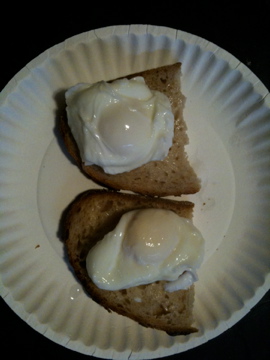
Much better!
Basically, my problem was that I was trying to keep all the white intact, when really only the inner whites need to cook with the yolk and the rest just melt away. So pretty much all you have to do is drop the egg in the water and don't touch it til it's done. Sorry Julia, but you made that way more complicated than necessary.

Eggs Benedict with Paprika
Monday, February 7, 2011
Food Rules
I finally got around to reading Michael Pollan's Food Rules today and managed to devour the entire book in about an hour. It essentially breaks down the last part of In Defense of Food, into 64 simple rules of thumb about food and eating. Below are some of my favorites and some comments on them:
• Rule #3: Avoid food products containing ingredients that no ordinary human would keep in the pantry. I've been doing a better job of checking ingredient lists lately and making sure I recognize everything on there. I've still bought a few things that broke this rule (Yoplait yogurt was on sale and it's got a few questionable ingredients, but I don't think I can get the hubby to eat real yogurt and it's a nice work snack).
• Rule #7: Avoid food products containing ingredients that a third-grader cannot pronounce. I finally got my husband on this one, because it was originally stated that if you couldn't pronounce it, it wasn't okay. My husband is about half a semester away from earning his PharmD, so he can pronounce most of that stuff and even knows what a lot of it is too. He seems to think that this knowledge makes it okay for consumption—but it's not. And now, with the new rule, he can't argue it anymore.
• Rule #13: Eat only foods that will eventually rot. I thought this was a good rule because it's the stuff that's really good for you in food that goes bad with time. That means that if it doesn't go bad, there's no good stuff in it. Interesting note: Pollan mentions that honey does, in fact, go bad. But it takes centuries. So now I know I never need to throw away honey again (Hint: If it crystallized, just throw it in the microwave until it's smooth again!).
• Rule #19: If it came from a plant, eat it; if it was made in a plant, don't. I just thought this was a funny (and true) play on words.
• Rule #23: Treat meat as a flavoring or special occasion food. So guilty of not doing this. I think I would be okay skipping meat more often—but hubby's gotta have his meat at almost every meal. His exceptions: pasta (sometimes), breakfast (sometimes), and PB&J. I'm going to try to make more foods without meat in them, but the trick is finding things he'll eat. Future goal, I think.
• Rule #24: "Eating what stands on one leg [mushrooms and plant foods] is better than eating what stands on two legs [fowl], which is better than eating what stands on four legs [cows, pigs, and other mammals]." I've heard this one before, although it was simpler: "The less legs, the better." This also accounted for the ultra healthy and leg-less fish. This one is a bit harder to follow for me too, because I like beef and pork so much more than chicken. I think chicken is kind of boring, or you have to add a lot to make it interesting. I do like fish though, but I've got to convince hubby before I can get more in the house.
• Rule #25: Eat your colors. This is another one I've heard before and I've done a better job as of late. Basically the different colors in your food represent different nutrients, so the more colorful your diet, the more nutrients you obtain.
• Rule #39: Eat all the junk food you want as long as you cook it yourself. Now I don't feel bad for making two cakes last week...
• Rule #43: Have a glass of wine with dinner. As Pollan noted, this rule is well-known but few recommend it because of the taboo surrounding alcohol and alcoholism in the United States. I've got a very good friend who is a recovering alcoholic, so I know the damages it can do. However, alcoholism is extremely low in Europe, where there are much lower (or effectively non-existent) drinking ages. This says to me that normalizing appropriate drinking behavior in your household will do good both for your physical and social/mental health.
• Rule #44: Pay more, eat less. As my previous post will attest, I wholeheartedly agree with this rule. We spend less of our budget on food than any other nation and we're eating junk. If we spent a little extra money on it, we could be eating so much better.
• Rule #49: Eat slowly. Another great piece of advice that goes unnoticed in the United States. We're all too busy to slow down and actually enjoy our food. My husband is a huge culprit of this: He will chide me when he's finished and I'm still only halfway through my meal. Sometimes it's hard though. I get either a 15-minute or a 30-minute break at my jobs, so if I want to eat, I basically have no choice but to scarf down while there's still time. When I only get a 15-minute break, I try to eat dinner already and just bring a small snack to tide me over.
• Rule #52: Buy smaller glasses and plates. Sometimes we'll eat off of the salad plates instead of the dinner plates, and it does make a big difference. I feel like I've eaten more than I have because my plate is so full. We have smaller glasses at the house, but I don't use them as often as I used to. I'll have to get back in the habit.
• Rule #54: "Breakfast like a king, lunch like a prince, dinner like a pauper." Excellent adage that I'm terrible about following. When I have to be somewhere in the morning, I usually get up about a half hour before I need to be there, which leaves pretty much no time for breakfast. Then, if I'm working, I won't eat lunch and so I'll be starving by the time dinner comes around and stuff my face. My P.E. teacher in high school once said that you shouldn't eat after 6 PM for the same reasons, so I try not to eat when it's really late, and I'm normally pretty good about it.
• Rule #59: Try not to eat alone. Again, this one's hard for me because my husband and I are often on different schedules and when I'm at work, I'm usually the only person on break. When I can eat with others though, I strongly prefer to do so.
• Rule #60: Treat treats as treats. Another funny and true play on words. It goes along with Rule #39 in saying that it's okay to eat things that are bad for you, as long as you don't do it every day.
• Rule #63: Cook. We've been doing a lot better about this and I feel like we've been spending less on food because we haven't been going out to eat as often as we used to.
• Rule #64: Break the rules once in a while. Nobody's perfect, and it's only going to hurt you if you obsess over your food all the time. Weight Watchers gives its clients extra points each week on top of their daily limit as special occasion or splurge points, and it's actually really good for you if you're trying to lose weight. This is because if the body figures out you're trying to starve it, it will start retaining every last morsel you put inside it. As such, you have to trick the body with special treats every now and then so it doesn't catch the scent. So you see, it's good for you to break the rules.
Excellent pocket reference for when I need a quick rule of thumb on food. Next on my list is a book I borrowed from my mom called Animal, Vegetable, Miracle. I also ordered Michael Pollan's first book and a couple books by Marion Nestle which should arrive later this week.
Friday, February 4, 2011
Grocery Shopping
I just got back from a grocery shopping trip, so I thought the topic would make a good post. (Note: I've been working on this post for almost a week now, so I've been to the store about five times since!)
I remember going grocery shopping with my parents often while I was growing up. We'd frequently go after church on Sunday (just like everyone else, it seemed), and always to the regional grocery chain in our area. Both of my parents would take my two younger siblings and me, but usually only one parent would go at a time. I'm sure we made them both miserable as the three of us would beg for every sugar-coated "non-food" that we came across, but my parents remained judicious and only gave in some of the time. Money for groceries never seemed to be an issue, so our cart was typically filled nearly full by the end of the trip. However, my mom used to clip coupons when I was very young, and there were a few things my parents would only buy when they were on sale (such as strawberries or yogurt), so food prices did affect our diet somewhat. We'd stroll down every aisle unless we were certain there was nothing in it we needed (i.e., the dog food aisle), and the whole trip probably took around an hour and a half.
We didn't buy organic, but I'm not even sure there was organic food available when I was a kid. We typically would buy some fresh fruit staples like bananas, apples, and oranges, but fresh vegetables were a little more uncommon. Sometimes we would get carrots or celery, and I think my mom would usually have a tomato on hand, but not much else. My mom was slightly more concerned about healthy eating (and subsequently enjoyed it more) than my dad, so I think she was usually the one buying the fresh produce.
Most of our meat was bought prepackaged, but our grocery store was (and still is) better than most about purchasing from reputable, local sources. It had a pretty good meat counter, and we would occasionally buy steaks or bacon wrapped chicken from them. We never bought fish though, or really any seafood. I don't think my parents really liked it (or perhaps didn't know much about cooking it), but my mom buys a lot more fish now.
We always bought white bread, so there is this special place in my heart that will always love it, even though I know I shouldn't eat it. We bought whole milk when I was younger, but switched to 2% once my siblings and I were older. I think at one point we tried to switch to 1%, but no one liked it so we went back to 2% (Though if my husband would drink it, I'd switch back to whole!). The rest of our cart was filled with "non-food" items like Cap'n Crunch, Pringles, and Pop-Tarts.
While we're on the subject of my grandmother this week, I went shopping with her a handful of times too. She shopped at the same chain as my parents for her big weekly trip, and bought much of the same things (except minus a lot of the kiddie food and in smaller amounts). When she needed to grab one or two things, however, she went to the family grocer about a block from her house.
I remember my grandmother would take my hand and we'd walk together down the street to the store. The clerks were all very friendly and knew my grandmother by name and chatted with her while she did her shopping. The store was about the size of the food section in a convenience store, and packed full of food. They also did a lot of butchering and so my grandmother may have gotten her meat here, but I can't remember for sure. The butchering was what eventually caused them to close, because the state made some law that lumped their butchering in with the big commercial butcher businesses and required them to have a different refrigeration system that was too big and too costly for their store. Hundreds, if not thousands, of locals protested the law and begged for them to make an exception, but their pleas ultimately fell on deaf ears, so one of the last of the family grocers in the area was forced to close.
Once I started shopping for myself, I shopped much the same way my parents did. I'd go to the same grocery chain and go down every aisle until my cart was full. I don't have as much food money as my parents, so I've been more judicious about my food selection. I try to pay attention to sales and won't buy a lot of things when they're not on sale. I've also become more interested in local, humane, and organic food, so I try to buy it when I can. This is not always easy, because sometimes it is astronomically more expensive than the regular stuff. For example, the chicken breasts I like to buy are antibiotic and hormone free, but it can cost up to $7.99/lb. The regular chicken breasts are often $1.99/lb. when they're on sale. It's hard to justify spending four times the amount, and so my husband will usually win out and we'll get the cheaper, regular chicken. But when there's only a dollar or two difference, I'll usually get the better chicken instead.
More recently, I've begun shopping at the local co-operative. I paid a $60 one-time membership fee (that I can get back at any time), and I am now a share-holder of this grocery store. They buy lots of seasonal produce and meat from local, organic farmers, they bake most of the bread they sell, and offer a lot of other healthy and "healthy" foods. The share-holders get to vote on what gets put on the shelves, so since I live in a very liberal, mid-sized Midwestern college town, there are many dedicated individuals who ensure honest, wholesome food is available.
This past week, I did the majority of my shopping at the co-op. I didn't make a list, but I did have a goal: To stay on the perimeter of the store. Michael Pollan has said that in most grocery stores, "real food" is always on the perimeter of the store (p. 157, In Defense of Food), and all the other "food" is in the middle. The one striking error to this is that nearly always the baking supply aisle (with flour, sugar, spices, etc) is always a center aisle. Olive oil is also mixed in with the dressing and what not, but most of those things are not needed on every trip, so I will let this factual error slide. Anyway, I successfully accomplished this goal on my trip. Here is what I bought and where I bought it in the store:
I began in the produce section, which is right in front of the main entrance. I chose to use a basket instead of a cart because I'm much less likely to buy too much food (However, I am probably more likely to over stuff the basket beyond what is easy to carry). The co-op sometimes has Fair Trade bananas (my previous trip they were just organic, but most of the time they get fair trade), so I grabbed four bananas. My husband is not a huge banana eater, but we both like them in smoothies when we make them; I usually grab four so that we'll each eat two before they turn brown. Cilantro and avocados were both on sale and I've been wanting to try to make guacamole, so I bought two avocados and a cilantro bunch. Navel oranges were on sale, so I bought one, and I decided I wanted to try a tangelo, so I bought one of those as well. We went through the red potatoes I bought last week, so I bought a few more this week. Blueberries were still on sale, but we had a whole container at home, so I skipped them this week.
Next I walked past the juice along the edge because it is sooo expensive (about $7-8 for a smallish container of real fruit juice). I got to the eggs and dairy next. The grocery store I usually go to has free-range, antibiotic free chicken eggs available from a local Mennonite farm, and the co-op also has these available. This time, I realized, they also have an organic version. It was a dollar extra per dozen, but I decided to go for it. I bought a small container of Greek yogurt last week and enjoyed it in my smoothies, so I bought a larger container this week. I was out of 2% milk at home, so I bought a quart of organic, grass-fed 2% milk. Lately, I haven't been drinking as much milk, so I decided to get the quart instead of the half gallon because my milk was going bad before I'd finish it.
I turned the corner and walked past the wine selection (which I'll save for another day, I'm sure) and headed for the meat counter. The co-op offers 100% grass-fed beef, which is hard to find without going directly through a local farmer. I had to double check because the sign only said "grass fed" and all cows are grass fed...until they reach the feedlot. Michael Pollan says we need to look for signs that say 100% grass fed, but the meat counter guy assured me it meant 100%, so I bought 2 lbs. ground beef and a chuck roast (one of my husband's favorite meals to cook!). I also bought a whole chicken, raised cage-free without antibiotics an hormones, etc.
Then I turned the corner again and found the bread area. I bought a small loaf of 100% whole wheat and some 100% whole wheat rolls.
I then reached the front of the store and checked out. The whole trip took about 20 minutes and cost me $57.20, which is much less than I typically spend at the grocery store (although I've been going weekly to the co-op instead of every three weeks or so to the regular grocery store).
All in all a success, but the co-op does have a few things missing from it. I had to go to the regular grocery store, and unfortunately Wal-Mart, to buy supplies for the cake-off (more on that later), and to get a few things my husband insists he can't live without. But as of right now, I'm willing to break down my shopping into multiple trips, so I think this will work.
I remember going grocery shopping with my parents often while I was growing up. We'd frequently go after church on Sunday (just like everyone else, it seemed), and always to the regional grocery chain in our area. Both of my parents would take my two younger siblings and me, but usually only one parent would go at a time. I'm sure we made them both miserable as the three of us would beg for every sugar-coated "non-food" that we came across, but my parents remained judicious and only gave in some of the time. Money for groceries never seemed to be an issue, so our cart was typically filled nearly full by the end of the trip. However, my mom used to clip coupons when I was very young, and there were a few things my parents would only buy when they were on sale (such as strawberries or yogurt), so food prices did affect our diet somewhat. We'd stroll down every aisle unless we were certain there was nothing in it we needed (i.e., the dog food aisle), and the whole trip probably took around an hour and a half.
We didn't buy organic, but I'm not even sure there was organic food available when I was a kid. We typically would buy some fresh fruit staples like bananas, apples, and oranges, but fresh vegetables were a little more uncommon. Sometimes we would get carrots or celery, and I think my mom would usually have a tomato on hand, but not much else. My mom was slightly more concerned about healthy eating (and subsequently enjoyed it more) than my dad, so I think she was usually the one buying the fresh produce.
Most of our meat was bought prepackaged, but our grocery store was (and still is) better than most about purchasing from reputable, local sources. It had a pretty good meat counter, and we would occasionally buy steaks or bacon wrapped chicken from them. We never bought fish though, or really any seafood. I don't think my parents really liked it (or perhaps didn't know much about cooking it), but my mom buys a lot more fish now.
We always bought white bread, so there is this special place in my heart that will always love it, even though I know I shouldn't eat it. We bought whole milk when I was younger, but switched to 2% once my siblings and I were older. I think at one point we tried to switch to 1%, but no one liked it so we went back to 2% (Though if my husband would drink it, I'd switch back to whole!). The rest of our cart was filled with "non-food" items like Cap'n Crunch, Pringles, and Pop-Tarts.
While we're on the subject of my grandmother this week, I went shopping with her a handful of times too. She shopped at the same chain as my parents for her big weekly trip, and bought much of the same things (except minus a lot of the kiddie food and in smaller amounts). When she needed to grab one or two things, however, she went to the family grocer about a block from her house.
I remember my grandmother would take my hand and we'd walk together down the street to the store. The clerks were all very friendly and knew my grandmother by name and chatted with her while she did her shopping. The store was about the size of the food section in a convenience store, and packed full of food. They also did a lot of butchering and so my grandmother may have gotten her meat here, but I can't remember for sure. The butchering was what eventually caused them to close, because the state made some law that lumped their butchering in with the big commercial butcher businesses and required them to have a different refrigeration system that was too big and too costly for their store. Hundreds, if not thousands, of locals protested the law and begged for them to make an exception, but their pleas ultimately fell on deaf ears, so one of the last of the family grocers in the area was forced to close.
Once I started shopping for myself, I shopped much the same way my parents did. I'd go to the same grocery chain and go down every aisle until my cart was full. I don't have as much food money as my parents, so I've been more judicious about my food selection. I try to pay attention to sales and won't buy a lot of things when they're not on sale. I've also become more interested in local, humane, and organic food, so I try to buy it when I can. This is not always easy, because sometimes it is astronomically more expensive than the regular stuff. For example, the chicken breasts I like to buy are antibiotic and hormone free, but it can cost up to $7.99/lb. The regular chicken breasts are often $1.99/lb. when they're on sale. It's hard to justify spending four times the amount, and so my husband will usually win out and we'll get the cheaper, regular chicken. But when there's only a dollar or two difference, I'll usually get the better chicken instead.
More recently, I've begun shopping at the local co-operative. I paid a $60 one-time membership fee (that I can get back at any time), and I am now a share-holder of this grocery store. They buy lots of seasonal produce and meat from local, organic farmers, they bake most of the bread they sell, and offer a lot of other healthy and "healthy" foods. The share-holders get to vote on what gets put on the shelves, so since I live in a very liberal, mid-sized Midwestern college town, there are many dedicated individuals who ensure honest, wholesome food is available.
This past week, I did the majority of my shopping at the co-op. I didn't make a list, but I did have a goal: To stay on the perimeter of the store. Michael Pollan has said that in most grocery stores, "real food" is always on the perimeter of the store (p. 157, In Defense of Food), and all the other "food" is in the middle. The one striking error to this is that nearly always the baking supply aisle (with flour, sugar, spices, etc) is always a center aisle. Olive oil is also mixed in with the dressing and what not, but most of those things are not needed on every trip, so I will let this factual error slide. Anyway, I successfully accomplished this goal on my trip. Here is what I bought and where I bought it in the store:
I began in the produce section, which is right in front of the main entrance. I chose to use a basket instead of a cart because I'm much less likely to buy too much food (However, I am probably more likely to over stuff the basket beyond what is easy to carry). The co-op sometimes has Fair Trade bananas (my previous trip they were just organic, but most of the time they get fair trade), so I grabbed four bananas. My husband is not a huge banana eater, but we both like them in smoothies when we make them; I usually grab four so that we'll each eat two before they turn brown. Cilantro and avocados were both on sale and I've been wanting to try to make guacamole, so I bought two avocados and a cilantro bunch. Navel oranges were on sale, so I bought one, and I decided I wanted to try a tangelo, so I bought one of those as well. We went through the red potatoes I bought last week, so I bought a few more this week. Blueberries were still on sale, but we had a whole container at home, so I skipped them this week.
Next I walked past the juice along the edge because it is sooo expensive (about $7-8 for a smallish container of real fruit juice). I got to the eggs and dairy next. The grocery store I usually go to has free-range, antibiotic free chicken eggs available from a local Mennonite farm, and the co-op also has these available. This time, I realized, they also have an organic version. It was a dollar extra per dozen, but I decided to go for it. I bought a small container of Greek yogurt last week and enjoyed it in my smoothies, so I bought a larger container this week. I was out of 2% milk at home, so I bought a quart of organic, grass-fed 2% milk. Lately, I haven't been drinking as much milk, so I decided to get the quart instead of the half gallon because my milk was going bad before I'd finish it.
I turned the corner and walked past the wine selection (which I'll save for another day, I'm sure) and headed for the meat counter. The co-op offers 100% grass-fed beef, which is hard to find without going directly through a local farmer. I had to double check because the sign only said "grass fed" and all cows are grass fed...until they reach the feedlot. Michael Pollan says we need to look for signs that say 100% grass fed, but the meat counter guy assured me it meant 100%, so I bought 2 lbs. ground beef and a chuck roast (one of my husband's favorite meals to cook!). I also bought a whole chicken, raised cage-free without antibiotics an hormones, etc.
Then I turned the corner again and found the bread area. I bought a small loaf of 100% whole wheat and some 100% whole wheat rolls.
I then reached the front of the store and checked out. The whole trip took about 20 minutes and cost me $57.20, which is much less than I typically spend at the grocery store (although I've been going weekly to the co-op instead of every three weeks or so to the regular grocery store).
All in all a success, but the co-op does have a few things missing from it. I had to go to the regular grocery store, and unfortunately Wal-Mart, to buy supplies for the cake-off (more on that later), and to get a few things my husband insists he can't live without. But as of right now, I'm willing to break down my shopping into multiple trips, so I think this will work.
Wednesday, January 26, 2011
Snacking
The other day while I was pining over In Defense of Food: An Eater's Manifesto, I toasted a couple slices of carrot bread to eat when I came across these words: "According to the Harvard economists' calculations, the bulk of the calories we've added to our diet over the past twenty years has come in the form of snacks," (p. 191).
Can someone say irony?
I did finish my toast regardless, and in fairness I had skipped lunch because I had a late breakfast. And it was carrot toast NOT potato chips! But still, Michael Pollan's message radiated through me: Food is meant to be eaten communally at meals, not every couple hours, alone.
I will be the first to admit, I am a very guilty snacker. And if yesterday was any indication, it will be a hard road to break that habit, too. It started late morning when I had to man a recruitment table for an organization I work with at my alma mater. I ran into an old friend manning another table covered in heart-shaped lollipops to lure unsuspecting recruits to them. Without even thinking about my goal to eat healthier, I took one and ate it! Then, they had a snack table and I eyed some scotcheroos. I thought to myself, My dog ate the leftover scotcheroos last week and I never got one. So I went to the table and got one. And some popcorn. Then I went back later and got another scotcheroo.
Then I stopped at the store on the way home to pick up the loaded baked potato bread they promised they were making yesterday and saw they had hummus on sale, so I grabbed a container. I came home and ate two pieces of carrot bread (this time with hummus). Then I ate the leftover tilapia ninety minutes before dinner! Then after dinner, I grabbed the hummus at the corn tortilla chips and ate again.
Yesterday was bad. But it certainly wasn't my worst day. And all things considered, I had skipped lunch again (I think I'm seeing a pattern here), and at least the second half of my snacking wasn't garbage food.
On the other hand, this may be the one thing I don't entirely agree with Michael Pollan on. Yes, I snacked too much yesterday. Yes, most snack food is junk food. Yes, it is much harder to control portions. But I thought it was better for your body if you ate several smaller, evenly spaced mini-meals throughout the day?
I think it's safe to say that I'm not going to give up snacking. Life does not always give us the opportunity to eat three square meals, and sometimes you need to get by with a couple midday snacks. However, I do need to be more mindful of what is in my snacks and how much snacking I do.
Perhaps the worst snacking I do is at work, and with good reason. I work long (up to 10) hours at the restaurant and my break is at the very beginning of my shift nine out of ten times. So to not snack, I would have to go the majority of my long shift without food while I watch other people scarf down right in front of me. What's worse is that free food is pretty readily available. Anytime a cook messes up an order, it generally gets put on the break table for us to devour (and let me tell you, our cooks are far from perfect!). Anytime we get new menu items (almost always plural), they make it for us to try. And to top it off, my workplace does not serve organic, all-vegan food. Or really anything close that at all. And most of it is cooked in oil.
So how do I escape probable tragedy? I could start by bringing my own snacks. I'm working on having more fresh fruits and veggies at the house, which are pretty good snack foods if you ask me. I typically bring my own "lunch," so adding a few extra goodies to snack on shouldn't be too hard. I work later today; we will test this hypothesis and see what happens.
As for at home, I really just need to monitor my impulse eating and try to eat something filling (aka not chips and hummus!) so I'm not tempted to go back to the kitchen for more. Probably the hardest part for me will be distinguishing between meals and snacks. Pollan strongly encourages eating with others, which can be difficult when my husband and I are on different schedules. He usually leaves before me and gets home after me during the week, especially on my days off, so I'm at home without supervision during those long hours between breakfast and dinner (since I seem to have this bad habit of skipping lunch). I keep trying to justify my snacking as a late lunch, but it's really not. Not the way I'm doing it. Maybe I just need to find a lunch buddy who will eat a late lunch with me. Or I need to sit at the table and set out exactly what I'm going to eat, instead of scrounging around until I think I'm full.
Hmm... more on that later I think.
Can someone say irony?
I did finish my toast regardless, and in fairness I had skipped lunch because I had a late breakfast. And it was carrot toast NOT potato chips! But still, Michael Pollan's message radiated through me: Food is meant to be eaten communally at meals, not every couple hours, alone.
I will be the first to admit, I am a very guilty snacker. And if yesterday was any indication, it will be a hard road to break that habit, too. It started late morning when I had to man a recruitment table for an organization I work with at my alma mater. I ran into an old friend manning another table covered in heart-shaped lollipops to lure unsuspecting recruits to them. Without even thinking about my goal to eat healthier, I took one and ate it! Then, they had a snack table and I eyed some scotcheroos. I thought to myself, My dog ate the leftover scotcheroos last week and I never got one. So I went to the table and got one. And some popcorn. Then I went back later and got another scotcheroo.
Then I stopped at the store on the way home to pick up the loaded baked potato bread they promised they were making yesterday and saw they had hummus on sale, so I grabbed a container. I came home and ate two pieces of carrot bread (this time with hummus). Then I ate the leftover tilapia ninety minutes before dinner! Then after dinner, I grabbed the hummus at the corn tortilla chips and ate again.
Yesterday was bad. But it certainly wasn't my worst day. And all things considered, I had skipped lunch again (I think I'm seeing a pattern here), and at least the second half of my snacking wasn't garbage food.
On the other hand, this may be the one thing I don't entirely agree with Michael Pollan on. Yes, I snacked too much yesterday. Yes, most snack food is junk food. Yes, it is much harder to control portions. But I thought it was better for your body if you ate several smaller, evenly spaced mini-meals throughout the day?
I think it's safe to say that I'm not going to give up snacking. Life does not always give us the opportunity to eat three square meals, and sometimes you need to get by with a couple midday snacks. However, I do need to be more mindful of what is in my snacks and how much snacking I do.
Perhaps the worst snacking I do is at work, and with good reason. I work long (up to 10) hours at the restaurant and my break is at the very beginning of my shift nine out of ten times. So to not snack, I would have to go the majority of my long shift without food while I watch other people scarf down right in front of me. What's worse is that free food is pretty readily available. Anytime a cook messes up an order, it generally gets put on the break table for us to devour (and let me tell you, our cooks are far from perfect!). Anytime we get new menu items (almost always plural), they make it for us to try. And to top it off, my workplace does not serve organic, all-vegan food. Or really anything close that at all. And most of it is cooked in oil.
So how do I escape probable tragedy? I could start by bringing my own snacks. I'm working on having more fresh fruits and veggies at the house, which are pretty good snack foods if you ask me. I typically bring my own "lunch," so adding a few extra goodies to snack on shouldn't be too hard. I work later today; we will test this hypothesis and see what happens.
As for at home, I really just need to monitor my impulse eating and try to eat something filling (aka not chips and hummus!) so I'm not tempted to go back to the kitchen for more. Probably the hardest part for me will be distinguishing between meals and snacks. Pollan strongly encourages eating with others, which can be difficult when my husband and I are on different schedules. He usually leaves before me and gets home after me during the week, especially on my days off, so I'm at home without supervision during those long hours between breakfast and dinner (since I seem to have this bad habit of skipping lunch). I keep trying to justify my snacking as a late lunch, but it's really not. Not the way I'm doing it. Maybe I just need to find a lunch buddy who will eat a late lunch with me. Or I need to sit at the table and set out exactly what I'm going to eat, instead of scrounging around until I think I'm full.
Hmm... more on that later I think.
Tuesday, January 25, 2011
Michael Pollan
The vast majority of the map for my food journey will likely be contained in the pages of Michael Pollan's books. I first heard of him through my Women and Food class, and he would occasionally pop up in my other food endeavors. My husband bought In Defense of Food: An Eater's Manifesto for me last summer, and I finally got around to reading it... yesterday. Let me tell you this:
Michael Pollan is my hero.
First of all, he is a journalist. His writing is simple and clear. He breaks down those lengthy and boring journal articles and puts them into plain English. Pollan does not claim to be an expert in food, but his words simply sum up all that is wrong with our eating habits and give us a straightforward solution. Eat Food. Not Too Much. Mostly Plants.
The book begins by telling us how our eating habits got so out of whack. As Pollan put it, "what other animal needs professional help in deciding what it should eat?" (p.2). Pollan chalks it up mostly to capitalism, which effectively destroyed our local food systems. In short, manufacturers began processing the food we eat to make it easier to carry it long distances without spoilage. As time goes on, much of the food we eat is hardly food at all, and it seriously lacks in variety. A whopping 1,670 calories (roughly two-thirds) of what we eat each day come from four plants: wheat (768 calories), corn (554 calories), soy (257 calories), and rice (91 calories) (p. 117).
Pollan discusses how scientists are attempting to reduce food to the nutrients that make it up, and then add those needed nutrients to the processed "food" to make it healthier. But much like the formula vs. breast milk debate, the real deal is always better for you. The Western diet has been linked to four of the top-ten causes of death in the United States, so the answer seems simple enough: Stop eating it. Unfortunately, Pollan says, there is hardly anything left in the supermarket that hasn't been tainted with science. So where does that leave people like me that want to make healthier food changes?
Pollan finishes to the book with some basic guidelines for good eating. Simply put, Eat Food. Not Too Much. Mostly Plants. Perhaps my favorite advice is to go back to your roots and eat the foods your great-grandmother would eat. Think about it, traditional ethnic fair has been around for hundreds of years. The food can't be that bad for you if it wasn't killing off your ancestors, right? Pollan also recommends eating as much local food as possible and even planting a garden if you're able.
All in all, a great read. I'm probably going to publish this post and then get on Amazon to order his other books.
Michael Pollan is my hero.
First of all, he is a journalist. His writing is simple and clear. He breaks down those lengthy and boring journal articles and puts them into plain English. Pollan does not claim to be an expert in food, but his words simply sum up all that is wrong with our eating habits and give us a straightforward solution. Eat Food. Not Too Much. Mostly Plants.
The book begins by telling us how our eating habits got so out of whack. As Pollan put it, "what other animal needs professional help in deciding what it should eat?" (p.2). Pollan chalks it up mostly to capitalism, which effectively destroyed our local food systems. In short, manufacturers began processing the food we eat to make it easier to carry it long distances without spoilage. As time goes on, much of the food we eat is hardly food at all, and it seriously lacks in variety. A whopping 1,670 calories (roughly two-thirds) of what we eat each day come from four plants: wheat (768 calories), corn (554 calories), soy (257 calories), and rice (91 calories) (p. 117).
Pollan discusses how scientists are attempting to reduce food to the nutrients that make it up, and then add those needed nutrients to the processed "food" to make it healthier. But much like the formula vs. breast milk debate, the real deal is always better for you. The Western diet has been linked to four of the top-ten causes of death in the United States, so the answer seems simple enough: Stop eating it. Unfortunately, Pollan says, there is hardly anything left in the supermarket that hasn't been tainted with science. So where does that leave people like me that want to make healthier food changes?
Pollan finishes to the book with some basic guidelines for good eating. Simply put, Eat Food. Not Too Much. Mostly Plants. Perhaps my favorite advice is to go back to your roots and eat the foods your great-grandmother would eat. Think about it, traditional ethnic fair has been around for hundreds of years. The food can't be that bad for you if it wasn't killing off your ancestors, right? Pollan also recommends eating as much local food as possible and even planting a garden if you're able.
All in all, a great read. I'm probably going to publish this post and then get on Amazon to order his other books.
Subscribe to:
Posts (Atom)