I'm currently working on Marion Nestle's book What to Eat, and just got done reading the section about fish. Despite the fact that fish are incredibly healthy for you (remember Michael Pollan's rule of thumb: The Less Legs, The Better?), there are some serious problems in the fishing industry that are often overlooked.
First, there's the obvious issue of overfishing. There are many species of fish that are being caught faster than they can reproduce, thus diminishing their numbers at a rapid pace. Popular fish like salmon, cod, and tuna; and delicacies like shark and octopus create a high demand...higher than what the Earth can sustain, and so their numbers are dwindling. Overfishing.org reports that 90 percent of large predatory fish are gone from the ocean.
One way the fish industry is addressing this problem is fish farming, which, while helpful when done appropriately, comes with its own set of issues, most notably fish feed. Carnivorous fish, like salmon, require pounds upon pounds of feeder fish for every pound of farmed fish, thus requiring even more fishing and ocean depletion. What's worse, is that many fish that don't typically eat much fish are being fed fish-based feed rather than a vegetarian feed. Further, fish from fish farms are sometimes genetically modified to allow for production in areas that wouldn't normally support this type of fish. When these farms are in open water systems (and they often are), these genetically modified fish can sometimes escape and then breed with wild fish. These "super fish" can also enter ecosystems that wouldn't normally sustain their breed, ultimately decimating feeder fish populations and starving larger predatory fish. Farmed fish are also frequently treated with antibiotics, and some fish (such as salmon) do not have the proper color because of the difference in diet, so the color is added artificially. Despite these issues, fish farming has its merits and can be a good alternative to overfishing when done right, and there are several certification programs to assess farming practices (the ASC just started certifying farmed tilapia; however, no other certification program has been officially approved by the US government).
Another big issue is methylmercury. Inorganic mercury has been released into the environment in rather large quantities, thanks in a large part to the burning of fossil fuels, but also to volcanoes, forest fires, etc. This mercury then makes its way to water systems, where it is converted to methylmercury. Methylmercury is then absorbed by oceanic wildlife and increases in concentration as you go up the food chain. As such, larger, carnivorous fish like shark and swordfish contain extremely high doses of mercury, which can cause a whole host of health problems, such as neurological damage, cardiovascular problems, and autoimmune disorders. These problems are particularly relevant for children and fetuses, who can show effects from much smaller doses.
PCBs are also a huge problem. Many of the Earth's watered are severely contaminated with PCBs originating from coolant fluids, plasticizers, paints, and a whole host of other things. Again, fish are contaminated with them and then the concentration grows and you climb the food chain. PCBs cause problems like skin conditions, liver damage, and cancer, and those issues are amplified in children, breastfeeding infants, and fetuses.
Clearly, there are serious issues with the fishing industry. What's worse, is that there is very little regulation in place to address them, and just as little done to identify problematic fishing practices to consumers. Country-of-origin labeling (COOL) went into effect in 2005 for all wild-caught fish, farmed fish, and shellfish (with exceptions for all "processed" fish). COOL is one way to determine the safety of fish, based on the water contamination in that country. Fish are also labeled as either "wild-caught" or "farmed," giving consumers another clue in their fish puzzle. Despite these labeling requirements, the labels are often incorrect, and even when they are correct, a consumer must be incredibly knowledgeable to be able to discern any meaning from these labels.
Some grocery stores, such as Whole Foods, label their fish using guides such as the Monterrey Bay Aquarium Seafood Watch or the Blue Ocean Institute Seafood Guide, which provide easy-to-understand ratings, such as "Best Choice," "Good Alternative," or "Avoid" for each type of fish they sell. Even more impressive, Whole Foods just announced that they will no longer sell wild-caught seafood with a Red/Avoid rating. And for those stores that don't display such informative labeling, these guides are also available as smartphone apps (which can also be used in restaurants, where labeling is not required). In spite of these efforts, the fishing industry has fought back ferociously. Many fisheries are disputing the credibility of these guides, rather than making an effort to change their practices.
In an effort to be more conscientious of my fish choices, I downloaded the MBA Seafood Guide app. Probably my biggest problem area so far has been sushi. Because I love spicy sushi and almost every spicy sushi roll has either tuna or salmon in it. Also, sushi restaurants don't typically include COOL (which makes it more difficult to determine the rating), so I would have to ask, and as I've mentioned before, I'm a wimp when it comes to asking about my food. But I went out for sushi the other day and got some spicy crawfish, that was super delicious.
I also bought some farmed Mediterranean Seabass today on the recommendation of another customer at Whole Foods. I didn't check the rating until after I'd purchased it, so it wasn't the best fish I could have picked, but not the worst either, at least. To add to my stupidity, here was my conversation with the guy behind the fish counter:
Me: "Could I get one of the smaller seabass? And could you skin it for me?"
Fish Guy: "...Skin it?"
Me: "Yeah. Skin it."
Fish Guy: "Do you mean 'scale' it? You want to keep the skin on, don't you?"
Me: "...Yeah. Well... you know what I mean."
So my snarky, know-it-all fish guy 'scaled' the fish for me and then offered to take the guts out as well. So I took my fish home and a few hours later, I opened up the package to find a fish that looked pretty much identical to the fish I saw in the display, except for the giant gash in the belly, where he probably took the guts out. It still had skin (although there weren't any scales to speak of). It still had bones. It still had fins. It still had a head.
This was a problem.
I wasn't feeling particularly well today and seriously considered putting the fish back in the fridge and dealing with it later, but I mustered up the energy to figure out what the heck to do with this fish in order to turn it into something I knew how to cook.
I figured it couldn't be that different from deboning a chicken, and I feel like I've seen someone just grab the head and pull all the bones out in one fell swoop, but I couldn't figure it out. So I ended up cutting the belly open all the way down to the back fin, where I managed to sort of lift out the bottom half of the spine... until it broke. Then I cut down either side of the remaining spine and just pulled it out. Then I had to go back for the little bitty rib bones or whatever you call them and pull them out individually with my fingers. Then I cut off the head and tail and fins and voilà! Two slightly ugly but totally cookable fish fillets! For reference, this seems like a much better way of doing it.
I put the fillets in an aluminum foil pouch, along with some butter, "minced" garlic, sea salt, and pepper. I also added some asparagus that I wrapped in bacon, and then sealed up the pouches. Then I cooked them at 400°F for about 20 minutes. And they were delicious! Since I wasn't feeling up to par, I didn't document the experience, but I'll likely do it again soon (preferably with a better fish) and I'll snap some pictures then. Hopefully I'll have perfected my fish deboning skills so you will all be impressed with my handy work... but that's pretty unlikely.
Showing posts with label books. Show all posts
Showing posts with label books. Show all posts
Sunday, April 8, 2012

Tuesday, February 14, 2012
Creamy Pesto
My new favorite meal is pasta with creamy pesto sauce, which I made on a creative whim the other day. I recently read Kitchen Counter Cooking School, which I'll review later, but one of the chapters talked about how inexpensive and easy it is to make pasta sauce, so I've been making lots of pasta sauce lately. In particular, I've been making lots of Alfredo sauce. Between Kitchen Counter Cooking School and Better Homes and Gardens, this is roughly my recipe:
1 clove garlic (chopped)
Olive oil
1 cup heavy whipping cream
Parmesan cheese
Salt
Pepper
Pasta water (optional)
Sauté garlic in olive oil in small sauce pan over medium heat. Add heavy whipping cream and stir occasionally. When sauce thickens to point where you can scrape with spoon and see bottom of the pan, add pasta water if you need more sauce and boil down to same thickness. If not, add Parmesan cheese, salt, and pepper. And voilà! Alfredo sauce.
I've also been making pesto with roughly this recipe:
Basil
Parsley
Olive oil
Pine nuts
Mix together in food processor or Magic Bullet until it looks like pesto. You can also add garlic and Parmesan cheese.
One thing I've learned is that you can spoon portions of fresh pesto into ice cube trays and freeze them for later use, which has been very handy since it's pretty much impossible to make one serving.
So one day, I was making pasta and couldn't decide if I wanted to use my frozen pesto or my heavy whipping cream before it went bad. And that's when I said, "Why don't I just mix them together?"

So basically I made my Alfredo sauce and then dropped a pesto cube into the pot and let it melt as I mixed it. Then I poured it over my pasta and it was perfect. The only downside is that I seem to be an expert at making exactly one serving too many and the Alfredo sauce tends to separate when I put it in the fridge. It still tastes fine but it's not the same as when it's fresh.
1 clove garlic (chopped)
Olive oil
1 cup heavy whipping cream
Parmesan cheese
Salt
Pepper
Pasta water (optional)
Sauté garlic in olive oil in small sauce pan over medium heat. Add heavy whipping cream and stir occasionally. When sauce thickens to point where you can scrape with spoon and see bottom of the pan, add pasta water if you need more sauce and boil down to same thickness. If not, add Parmesan cheese, salt, and pepper. And voilà! Alfredo sauce.
I've also been making pesto with roughly this recipe:
Basil
Parsley
Olive oil
Pine nuts
Mix together in food processor or Magic Bullet until it looks like pesto. You can also add garlic and Parmesan cheese.
One thing I've learned is that you can spoon portions of fresh pesto into ice cube trays and freeze them for later use, which has been very handy since it's pretty much impossible to make one serving.
So one day, I was making pasta and couldn't decide if I wanted to use my frozen pesto or my heavy whipping cream before it went bad. And that's when I said, "Why don't I just mix them together?"

Best. Idea. Ever.
So basically I made my Alfredo sauce and then dropped a pesto cube into the pot and let it melt as I mixed it. Then I poured it over my pasta and it was perfect. The only downside is that I seem to be an expert at making exactly one serving too many and the Alfredo sauce tends to separate when I put it in the fridge. It still tastes fine but it's not the same as when it's fresh.
Friday, September 23, 2011
Food Politics
I finally finished reading "Food Politics" by Marion Nestle last month. I'm not gonna lie, it's kind of a tough read, but definitely worth it.
Basically, the whole point of the book is to bring attention to the fact that the FDA basically has no power and every time it tries to assert itself, it loses even more ground. Nestle discusses this from several different angles and also gives a rough time line of what the FDA has done (or been stopped from doing) over the last 40 or so years.
What was especially disparaging was the way food companies began being able to put "health claims" on their packaging and in their advertising, mostly thanks to the supplement industry. The supplement industry helped build a grassroots effort to allow consumers the "right to choose" what is best for them. After the passage of the Dietary Supplement Health and Education Act of 1994 (DSHEA), the supplement industry was allowed to put health claims on their products, even if those claims had little or no scientific evidence to back them up. Following this was the creation of functional foods, the sole purpose of which is to act as a "healthier" alternative to traditional food. Companies marketing functional foods made the claim that these foods had added supplements and under DSHEA, they had the right to advertise the things that made them so "healthy."And so they did. And now everything in the supermarket seems to have one health claim or another on it.
Furthermore, the FDA seems to be blocked from every possible side. Nestle talked about her time working on the Surgeon General's Report on Nutrition and Health, and how she was explicitly told she would not be allowed to make any recommendations that would suggest that a person eat less of any particular food because the food industry would pull its financial support from the elected officials responsible for its release. As such, Nestle had to resort to attacking specific nutrients rather than types of food. Instead of telling people to eat less red meat, she had to say "Choose a diet low in saturated fat." These types of statements are confusing to consumers and allow other equally unhealthy foods to take advantage of advertising their low-fat status (even though they are full of sugar or high fructose corn syrup). Even more interestingly, the FDA has no control over what gets put in advertising that is not on the package, because that has to go through the FCC.
What's worse is that the FDA has 120 days from when a food company petitions to put a health claim on its product to determine if the claim is accurate and must prove it is inaccurate within that time frame in order to prohibit its use. If the 120 days expires, the claim is automatically approved. And should the FDA later determine the product is unsafe, the FDA can't actually do anything about it. They can only "request" that a food company recall the product. As you can imagine, the FDA is totally underfunded for such a task and so most of these petitions go through without so much as an eyelash batted at them.
Nestle's book is very technical, so it's a slow read. But the information is invaluable and really makes me think carefully about the health claims I hear, where I hear them, and who is paying for them. As Michael Pollan said, if a food makes a health claim, it probably isn't real food. Words to live by right there.
In other book news, I'm currently working on "The Story of Sushi" by Trevor Corson, which is mostly a bookumentary on a group of aspiring sushi chefs. Most of it is sort of funny stories about their time at sushi school, but there are a lot of interesting bits about how sushi is made traditionally and how sushi has changed over time and since its arrival in the United States. I don't have much time for it now that school is started, but I'm slowly working my way through it. I also bought a fun book called "Insanewiches" by Adrian Fiorino, which is basically a picture/cook book of crazy sandwiches. Not all of them are healthy (Most notably the Quadruple Down, featuring four fried chicken breasts, bacon, cheese, mayo, etc. I'm having a heart attack just looking at the picture), but there are many that are at least reasonably good for you. And they're cute. So I will probably make some and post them on here at some point.
Basically, the whole point of the book is to bring attention to the fact that the FDA basically has no power and every time it tries to assert itself, it loses even more ground. Nestle discusses this from several different angles and also gives a rough time line of what the FDA has done (or been stopped from doing) over the last 40 or so years.
What was especially disparaging was the way food companies began being able to put "health claims" on their packaging and in their advertising, mostly thanks to the supplement industry. The supplement industry helped build a grassroots effort to allow consumers the "right to choose" what is best for them. After the passage of the Dietary Supplement Health and Education Act of 1994 (DSHEA), the supplement industry was allowed to put health claims on their products, even if those claims had little or no scientific evidence to back them up. Following this was the creation of functional foods, the sole purpose of which is to act as a "healthier" alternative to traditional food. Companies marketing functional foods made the claim that these foods had added supplements and under DSHEA, they had the right to advertise the things that made them so "healthy."And so they did. And now everything in the supermarket seems to have one health claim or another on it.
Furthermore, the FDA seems to be blocked from every possible side. Nestle talked about her time working on the Surgeon General's Report on Nutrition and Health, and how she was explicitly told she would not be allowed to make any recommendations that would suggest that a person eat less of any particular food because the food industry would pull its financial support from the elected officials responsible for its release. As such, Nestle had to resort to attacking specific nutrients rather than types of food. Instead of telling people to eat less red meat, she had to say "Choose a diet low in saturated fat." These types of statements are confusing to consumers and allow other equally unhealthy foods to take advantage of advertising their low-fat status (even though they are full of sugar or high fructose corn syrup). Even more interestingly, the FDA has no control over what gets put in advertising that is not on the package, because that has to go through the FCC.
What's worse is that the FDA has 120 days from when a food company petitions to put a health claim on its product to determine if the claim is accurate and must prove it is inaccurate within that time frame in order to prohibit its use. If the 120 days expires, the claim is automatically approved. And should the FDA later determine the product is unsafe, the FDA can't actually do anything about it. They can only "request" that a food company recall the product. As you can imagine, the FDA is totally underfunded for such a task and so most of these petitions go through without so much as an eyelash batted at them.
Nestle's book is very technical, so it's a slow read. But the information is invaluable and really makes me think carefully about the health claims I hear, where I hear them, and who is paying for them. As Michael Pollan said, if a food makes a health claim, it probably isn't real food. Words to live by right there.
In other book news, I'm currently working on "The Story of Sushi" by Trevor Corson, which is mostly a bookumentary on a group of aspiring sushi chefs. Most of it is sort of funny stories about their time at sushi school, but there are a lot of interesting bits about how sushi is made traditionally and how sushi has changed over time and since its arrival in the United States. I don't have much time for it now that school is started, but I'm slowly working my way through it. I also bought a fun book called "Insanewiches" by Adrian Fiorino, which is basically a picture/cook book of crazy sandwiches. Not all of them are healthy (Most notably the Quadruple Down, featuring four fried chicken breasts, bacon, cheese, mayo, etc. I'm having a heart attack just looking at the picture), but there are many that are at least reasonably good for you. And they're cute. So I will probably make some and post them on here at some point.
Monday, March 14, 2011
I Like the Juice (Juice Juice)
While I was at the co-op grocery store today, I came across some juicing oranges. A juicing orange is one with lots of juice inside and relatively few seeds, so it will be heavier than a regular orange. I bought eight of them and decided I wanted to try to make orange juice.
Maybe a month or so ago, I inherited an electric juicer from... I don't remember. All I remember is that my husband brought it home one day for me. I thought it was kind of cool, stuck it in my cupboard and thought very little about it since.
Then today I pulled it out and made myself a little orange juice. I had no instructions, so I could already tell this was going to be an adventure, but it was actually very straightforward and easy. I cut two oranges in half and stuck the halves right on the juicer and watched as streams of yummy orange juice flowed down into the collection container. The two (smallish) oranges made about half a glass, so I think about four oranges per serving would be about right.
The juice was pretty good, but a little bit bland (I prefer tart orange juice). Of course, now that I know how easy it is to make orange juice, my next step will be making freshly squeezed lemonade, which will more than likely be amazing. Or perhaps I will make some citrus fruit blend with grapefruits and oranges and whatever else I find.
Nonetheless, I think we will be hearing more about my juicer creations in the near future.
In other news, I bought the stuff for my great-grandmother's hot cross buns, so I think I'll make them on Thursday this week. Also, I've been craving pizza like none other, so I think I'm going to check out the pizza recipe from Animal, Vegetable, Miracle sometime this week too.
EDIT: I made breakfast a few days later and had a full glass of orange juice (made with four oranges), and that was way too much! It dawned on me that it was like eating four oranges in addition to my breakfast. So, two oranges should be plenty for a small orange juice glass.
Maybe a month or so ago, I inherited an electric juicer from... I don't remember. All I remember is that my husband brought it home one day for me. I thought it was kind of cool, stuck it in my cupboard and thought very little about it since.
Then today I pulled it out and made myself a little orange juice. I had no instructions, so I could already tell this was going to be an adventure, but it was actually very straightforward and easy. I cut two oranges in half and stuck the halves right on the juicer and watched as streams of yummy orange juice flowed down into the collection container. The two (smallish) oranges made about half a glass, so I think about four oranges per serving would be about right.
The juice was pretty good, but a little bit bland (I prefer tart orange juice). Of course, now that I know how easy it is to make orange juice, my next step will be making freshly squeezed lemonade, which will more than likely be amazing. Or perhaps I will make some citrus fruit blend with grapefruits and oranges and whatever else I find.
Nonetheless, I think we will be hearing more about my juicer creations in the near future.
In other news, I bought the stuff for my great-grandmother's hot cross buns, so I think I'll make them on Thursday this week. Also, I've been craving pizza like none other, so I think I'm going to check out the pizza recipe from Animal, Vegetable, Miracle sometime this week too.
EDIT: I made breakfast a few days later and had a full glass of orange juice (made with four oranges), and that was way too much! It dawned on me that it was like eating four oranges in addition to my breakfast. So, two oranges should be plenty for a small orange juice glass.
Thursday, March 10, 2011
Oatmeal Crispies
For this week's recipe from my grandmother's cookbooks, I finally pulled a recipe from the PTA cookbook. I chose Mrs. John Palmer's recipe for Oatmeal Crispies because I had all the ingredients and it looked simple enough. The instructions were not fail-proof, but I was feeling adventurous. Here is the recipe (I halved it because I always make way too many cookies!):
1 cup fat (I used butter)
1 cup brown sugar
1 cup white sugar
1 1/2 cups sifted flour
3 cups quick cooking oatmeal
1 tsp. baking soda
1 tsp. baking powder
1/2 tsp. salt
1 tsp. vanilla
Make into roll and chill or form into balls and press out with a fork. This recipe makes about 4 dozen cookies, and they are good.
Not gonna lie, when I first read the recipe, I said to myself: Oh cool. I don't even have to bake them.
But then I thought about it some more, because there's raw egg, baking powder and baking soda in the recipe. Wait a minute, I thought, why would you put baking powder and baking soda in something you weren't going to bake? And why does she call them cookies later? Cookies are baked.
So after a short debate with myself, I decided these were, in fact, meant to be baked cookies. Then I gave my best annoyed face to the more-than-likely-late-Mrs.-John-Palmer for not giving me some kind of baking instructions. Any kind of baking instructions. Seriously, who bakes cookies by chilling them?!
After looking at a few more cookie recipes, I decided to just wing it. I put them in the oven for 9-10 minutes at 350 degrees, and they came out perfectly. Win. And they were good. Double win.
I do want to try to make my great grandmother's hot cross buns recipe, but I need to buy raisins, yeast, and allspice beforehand. Maybe next week I'll be feeling that ambitious.
I started Food Politics this week, but it's been slow-going and I'm not even out of the introduction yet. I think I'm going to like it though, once I get enough time to sit down and enjoy it for an hour or two.
1 cup fat (I used butter)
1 cup brown sugar
1 cup white sugar
1 1/2 cups sifted flour
3 cups quick cooking oatmeal
1 tsp. baking soda
1 tsp. baking powder
1/2 tsp. salt
1 tsp. vanilla
Make into roll and chill or form into balls and press out with a fork. This recipe makes about 4 dozen cookies, and they are good.
Not gonna lie, when I first read the recipe, I said to myself: Oh cool. I don't even have to bake them.
But then I thought about it some more, because there's raw egg, baking powder and baking soda in the recipe. Wait a minute, I thought, why would you put baking powder and baking soda in something you weren't going to bake? And why does she call them cookies later? Cookies are baked.
So after a short debate with myself, I decided these were, in fact, meant to be baked cookies. Then I gave my best annoyed face to the more-than-likely-late-Mrs.-John-Palmer for not giving me some kind of baking instructions. Any kind of baking instructions. Seriously, who bakes cookies by chilling them?!
After looking at a few more cookie recipes, I decided to just wing it. I put them in the oven for 9-10 minutes at 350 degrees, and they came out perfectly. Win. And they were good. Double win.
I do want to try to make my great grandmother's hot cross buns recipe, but I need to buy raisins, yeast, and allspice beforehand. Maybe next week I'll be feeling that ambitious.
I started Food Politics this week, but it's been slow-going and I'm not even out of the introduction yet. I think I'm going to like it though, once I get enough time to sit down and enjoy it for an hour or two.
Monday, March 7, 2011
Animal, Vegetable, Miracle
I finally finished reading Barbara Kingsolver's book, Animal, Vegetable, Miracle this morning. I thoroughly enjoyed it and it brought to my attention a lot of food issues that I hadn't thought of before, but there was one thing that just didn't rub me the right way.
The premise of the book is that Kingsolver and her family decide to eat nothing but local food for an entire year, but they seem to break the rules every chance they get! They start off immediately breaking the rules by allowing for several exceptions right off the bat. They are allowed to eat grains and olive oil based on the simple fact that those things just aren't available locally. Okay, I said to myself, those are kind of necessities and if there's no way to get those locally, it's at least a step in the right direction. Then, on top of that, each family member got one "freebie" food: coffee, dried fruit, hot chocolate, and spices. Alright, I'll let that slide too. In fairness, they were buying those things from farmers who got fair wages and practiced sustainable agriculture, which is also important, and everyone needs a treat now and then.
But then they went on not one, but two multi-week vacations over the course of the year. And yes, they ate local foods from their vacation sites, sometimes, but not always. And they ate at friends' houses who didn't follow their locavore lifestyle and even ate out at restaurants that didn't serve local food on occasion.
Now don't get me wrong. Kingsolver and her family did a much better job of eating local, sustainable, and organic food than I do and probably better than I ever will. They grew a huge garden and raised their own animals and bought plenty of food from local farmers. And the vast majority of their food was local. But the thing here is that this was hardly a change for them. They already ate out of their garden previously and bought lots of food from the farmer's market and made an effort to eat local whenever possible. My point is, how is this any different than what they already did? They stepped it up a notch, but they really didn't go all the way, as the book promised in the beginning.
That being said, Kingsolver did an excellent job of making me appreciate and understand the importance of purchasing local food. I already knew it was important because you put money back into your local economy and it's fresher and all that. But one thing I never really thought about was all of the fossil fuels it takes to get food from all over the world to the grocery store. If we ate locally grown food instead, the fuel cost would be practically non-existent. Even doing something as simple as buying fruits and vegetables at the farmer's market instead of the grocery store would make a huge difference.
One other thing I really liked about the book was the inclusion of so many recipes they used to make locally produced breakfasts, lunches, and dinners. Once spring starts to roll around, I'll have to try to make some of these when the produce is in season.
I also appreciated the alternating format of the book. Most of the story is told through Kingsolver, but her older daughter, Camille, had an essay related to Kingsolver's story at the end of most chapters. And Kingsolver's husband, Steven Hopp, interjected with relevant facts and statistics throughout the narrative as well. The writing is charming, witty, and endearing. I could feel the happiness, worry, pride, and panic in Kingsolver's words, and her passion fueled my desire to eat better. I think the next book I'll work on is Marion Nestle's Food Politics. Michael Pollan referenced this one several times in his works, so it's likely awesome.
On that note, I went to the co-op grocery store today and picked up a few more local items than usual. After I went through nearly two dozen eggs last week, I snatched up a carton of my usual cage-free organic eggs. But just as I was about to walk away, I saw a row of plain egg cartons and all that was stamped on them was the name of the farm and the city where they farmed. My city. Without a second thought, I checked the local eggs for cracks and put back my usual eggs. I also found a brand of cottage cheese made on a farm only 20 miles from where I live, so I grabbed some to make lasagna this week. I also got another whole chicken from a local farm, and I bought bread baked at the co-op rather than baked elsewhere and then shipped to the co-op, so it saved a little gas there.
Also, one of my cooks at work read about my poached egg fiasco and gave me a little pep talk (re: made fun of me). So I watched him poach a couple eggs this weekend, and retried poaching eggs on Saturday afternoon. Here are my results:


The premise of the book is that Kingsolver and her family decide to eat nothing but local food for an entire year, but they seem to break the rules every chance they get! They start off immediately breaking the rules by allowing for several exceptions right off the bat. They are allowed to eat grains and olive oil based on the simple fact that those things just aren't available locally. Okay, I said to myself, those are kind of necessities and if there's no way to get those locally, it's at least a step in the right direction. Then, on top of that, each family member got one "freebie" food: coffee, dried fruit, hot chocolate, and spices. Alright, I'll let that slide too. In fairness, they were buying those things from farmers who got fair wages and practiced sustainable agriculture, which is also important, and everyone needs a treat now and then.
But then they went on not one, but two multi-week vacations over the course of the year. And yes, they ate local foods from their vacation sites, sometimes, but not always. And they ate at friends' houses who didn't follow their locavore lifestyle and even ate out at restaurants that didn't serve local food on occasion.
Now don't get me wrong. Kingsolver and her family did a much better job of eating local, sustainable, and organic food than I do and probably better than I ever will. They grew a huge garden and raised their own animals and bought plenty of food from local farmers. And the vast majority of their food was local. But the thing here is that this was hardly a change for them. They already ate out of their garden previously and bought lots of food from the farmer's market and made an effort to eat local whenever possible. My point is, how is this any different than what they already did? They stepped it up a notch, but they really didn't go all the way, as the book promised in the beginning.
That being said, Kingsolver did an excellent job of making me appreciate and understand the importance of purchasing local food. I already knew it was important because you put money back into your local economy and it's fresher and all that. But one thing I never really thought about was all of the fossil fuels it takes to get food from all over the world to the grocery store. If we ate locally grown food instead, the fuel cost would be practically non-existent. Even doing something as simple as buying fruits and vegetables at the farmer's market instead of the grocery store would make a huge difference.
One other thing I really liked about the book was the inclusion of so many recipes they used to make locally produced breakfasts, lunches, and dinners. Once spring starts to roll around, I'll have to try to make some of these when the produce is in season.
I also appreciated the alternating format of the book. Most of the story is told through Kingsolver, but her older daughter, Camille, had an essay related to Kingsolver's story at the end of most chapters. And Kingsolver's husband, Steven Hopp, interjected with relevant facts and statistics throughout the narrative as well. The writing is charming, witty, and endearing. I could feel the happiness, worry, pride, and panic in Kingsolver's words, and her passion fueled my desire to eat better. I think the next book I'll work on is Marion Nestle's Food Politics. Michael Pollan referenced this one several times in his works, so it's likely awesome.
On that note, I went to the co-op grocery store today and picked up a few more local items than usual. After I went through nearly two dozen eggs last week, I snatched up a carton of my usual cage-free organic eggs. But just as I was about to walk away, I saw a row of plain egg cartons and all that was stamped on them was the name of the farm and the city where they farmed. My city. Without a second thought, I checked the local eggs for cracks and put back my usual eggs. I also found a brand of cottage cheese made on a farm only 20 miles from where I live, so I grabbed some to make lasagna this week. I also got another whole chicken from a local farm, and I bought bread baked at the co-op rather than baked elsewhere and then shipped to the co-op, so it saved a little gas there.
Also, one of my cooks at work read about my poached egg fiasco and gave me a little pep talk (re: made fun of me). So I watched him poach a couple eggs this weekend, and retried poaching eggs on Saturday afternoon. Here are my results:
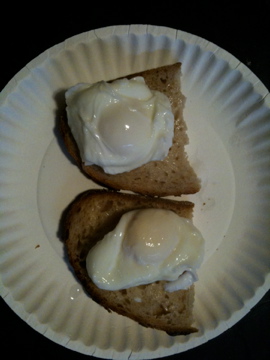
Much better!
Basically, my problem was that I was trying to keep all the white intact, when really only the inner whites need to cook with the yolk and the rest just melt away. So pretty much all you have to do is drop the egg in the water and don't touch it til it's done. Sorry Julia, but you made that way more complicated than necessary.

Eggs Benedict with Paprika
Friday, February 11, 2011
Butter
Last week, my cousin posted an article about making your own organic butter on Facebook. Ah ha! I said to myself, This will be perfect for my blog! So since I'm working doubles the entire weekend, I figured I should get this one in before I do nothing but eat, sleep, and work for the next couple days.
But first a few notes about the butter and margarine debate. I think we used butter mostly at my house, but I can't say for sure. I think it was pretty interchangeable, but from what I can remember, we had Land O Lakes butter sitting out on the table (rarely in the fridge) most of the time. I liked that we kept it at room temperature because it was actually possible to spread it on foods that were not scalding hot.
When I got married, I'm pretty sure we switched over to margarine, because that's what my husband was used to using, and I didn't have much of a preference at the time. But then I found out the awful truth about margarine: It's bad for you.
Long story short, it's imitation butter. And imitation is never better than the real thing. It goes back to the removal of the saturated fats and replacing it with scientifically engineered compounds like trans-fats, and we all know trans-fats are big no-nos.
So then I tried buying butter at the co-op grocery store. Surprisingly, they had about 15 different kinds of margarine and exactly one kind of butter. Sweet cream butter that had to be refrigerated and was hard as a rock. This would not fly with my husband. So we went back to the margarine until I recently found Land O Lakes spreadable butter with canola oil at the regular grocery store. They had a few more options there as well, but I'm happy with the canola oil mix for now and my husband will use it so everyone is satisfied.
So anyway, I decided on a whim at about 8 o'clock tonight to make my own butter using the article I mentioned previously. It claimed the process took ten minutes, so I figured why not?
I had already obtained organic heavy whipping cream ahead of time, and the only other ingredients are an electric mixer, ice water, and sea salt (to taste), so I was ready to go a few minutes after eight. The first step was to mix the whipping cream until it became a butter-like substance, which, supposedly takes about 10 minutes. I think it ended up taking me closer to 20, but it was a bit extended because I had to check the bowl several times to see if buttermilk was separating from the butter at the bottom. When it was finally separated, I had to find a couple containers appropriate for saving the buttermilk and coax said liquid into the containers while simultaneously not including the butter. This probably took another five minutes or so.
After that I had to check my freezer to see if we had ice cubes ready (we did, yay!) and pour the ice water into the bowl to wash the butter and try to remove more buttermilk. I washed it three times and the water began running clearer, so I figured I was good to go. The last step was to remove the rest of the liquid and then salt and wrap it up. Well, this whole removing the rest of the liquid part was probably the most time consuming part of the task. I squeezed and squeezed out liquid with my spoonula until I couldn't get any more out and so I went to salt and wrap up the butter and call it a day. But when I picked it up and tried to mold it into some cute, square-ish shape, I realized there was a ton of liquid still inside the butter ball. So I tried squeezing out more liquid with the spoonula, but none would come out. I finally resorted to squeezing out the liquid as best I could with my bare hands until I finally gave up and figured it was good enough. This whole process probably took me another 20 minutes or so.
Then there was the task of trying to figure out how to shape it into a cute little butter block. Well, I didn't really have any ideas, so after a few sorry attempts I ended up just lining a storage container with wax paper and shaping the butter to the container shape. I think in the end it took me about 50 minutes from start to finish, but I think I could shorten this to about 30 minutes or so once I've done it a few more times. I plan on taking some of the butter to work tomorrow and trying it out, along with some of the buttermilk. I think I'll put the butter on my roasted garlic sourdough bread I bought to go with the lasagna I made for lunch (and have for leftovers tomorrow!). No idea on the buttermilk. I may just add it to some oatmeal. Pretty excited about the whole thing, nonetheless.
In other news, Animal, Vegetable, Miracle is fascinating and makes me want to garden more than ever. I'm very disappointed that I'll be moving mid-summer and so a garden is out of the question again this year. Last year they dug up my backyard to do work on the downstairs duplex, so it was a no go. Before that I didn't have yard space to call my own, so I haven't had the chance to try it out. Hopefully next year though. However, I just got done reading the part where the author learned how to make cheese, and it seems about as easy as making butter, so I think that will be my next project.
But first a few notes about the butter and margarine debate. I think we used butter mostly at my house, but I can't say for sure. I think it was pretty interchangeable, but from what I can remember, we had Land O Lakes butter sitting out on the table (rarely in the fridge) most of the time. I liked that we kept it at room temperature because it was actually possible to spread it on foods that were not scalding hot.
When I got married, I'm pretty sure we switched over to margarine, because that's what my husband was used to using, and I didn't have much of a preference at the time. But then I found out the awful truth about margarine: It's bad for you.
Long story short, it's imitation butter. And imitation is never better than the real thing. It goes back to the removal of the saturated fats and replacing it with scientifically engineered compounds like trans-fats, and we all know trans-fats are big no-nos.
So then I tried buying butter at the co-op grocery store. Surprisingly, they had about 15 different kinds of margarine and exactly one kind of butter. Sweet cream butter that had to be refrigerated and was hard as a rock. This would not fly with my husband. So we went back to the margarine until I recently found Land O Lakes spreadable butter with canola oil at the regular grocery store. They had a few more options there as well, but I'm happy with the canola oil mix for now and my husband will use it so everyone is satisfied.
So anyway, I decided on a whim at about 8 o'clock tonight to make my own butter using the article I mentioned previously. It claimed the process took ten minutes, so I figured why not?
I had already obtained organic heavy whipping cream ahead of time, and the only other ingredients are an electric mixer, ice water, and sea salt (to taste), so I was ready to go a few minutes after eight. The first step was to mix the whipping cream until it became a butter-like substance, which, supposedly takes about 10 minutes. I think it ended up taking me closer to 20, but it was a bit extended because I had to check the bowl several times to see if buttermilk was separating from the butter at the bottom. When it was finally separated, I had to find a couple containers appropriate for saving the buttermilk and coax said liquid into the containers while simultaneously not including the butter. This probably took another five minutes or so.
After that I had to check my freezer to see if we had ice cubes ready (we did, yay!) and pour the ice water into the bowl to wash the butter and try to remove more buttermilk. I washed it three times and the water began running clearer, so I figured I was good to go. The last step was to remove the rest of the liquid and then salt and wrap it up. Well, this whole removing the rest of the liquid part was probably the most time consuming part of the task. I squeezed and squeezed out liquid with my spoonula until I couldn't get any more out and so I went to salt and wrap up the butter and call it a day. But when I picked it up and tried to mold it into some cute, square-ish shape, I realized there was a ton of liquid still inside the butter ball. So I tried squeezing out more liquid with the spoonula, but none would come out. I finally resorted to squeezing out the liquid as best I could with my bare hands until I finally gave up and figured it was good enough. This whole process probably took me another 20 minutes or so.
Then there was the task of trying to figure out how to shape it into a cute little butter block. Well, I didn't really have any ideas, so after a few sorry attempts I ended up just lining a storage container with wax paper and shaping the butter to the container shape. I think in the end it took me about 50 minutes from start to finish, but I think I could shorten this to about 30 minutes or so once I've done it a few more times. I plan on taking some of the butter to work tomorrow and trying it out, along with some of the buttermilk. I think I'll put the butter on my roasted garlic sourdough bread I bought to go with the lasagna I made for lunch (and have for leftovers tomorrow!). No idea on the buttermilk. I may just add it to some oatmeal. Pretty excited about the whole thing, nonetheless.
In other news, Animal, Vegetable, Miracle is fascinating and makes me want to garden more than ever. I'm very disappointed that I'll be moving mid-summer and so a garden is out of the question again this year. Last year they dug up my backyard to do work on the downstairs duplex, so it was a no go. Before that I didn't have yard space to call my own, so I haven't had the chance to try it out. Hopefully next year though. However, I just got done reading the part where the author learned how to make cheese, and it seems about as easy as making butter, so I think that will be my next project.
Monday, February 7, 2011
Food Rules
I finally got around to reading Michael Pollan's Food Rules today and managed to devour the entire book in about an hour. It essentially breaks down the last part of In Defense of Food, into 64 simple rules of thumb about food and eating. Below are some of my favorites and some comments on them:
• Rule #3: Avoid food products containing ingredients that no ordinary human would keep in the pantry. I've been doing a better job of checking ingredient lists lately and making sure I recognize everything on there. I've still bought a few things that broke this rule (Yoplait yogurt was on sale and it's got a few questionable ingredients, but I don't think I can get the hubby to eat real yogurt and it's a nice work snack).
• Rule #7: Avoid food products containing ingredients that a third-grader cannot pronounce. I finally got my husband on this one, because it was originally stated that if you couldn't pronounce it, it wasn't okay. My husband is about half a semester away from earning his PharmD, so he can pronounce most of that stuff and even knows what a lot of it is too. He seems to think that this knowledge makes it okay for consumption—but it's not. And now, with the new rule, he can't argue it anymore.
• Rule #13: Eat only foods that will eventually rot. I thought this was a good rule because it's the stuff that's really good for you in food that goes bad with time. That means that if it doesn't go bad, there's no good stuff in it. Interesting note: Pollan mentions that honey does, in fact, go bad. But it takes centuries. So now I know I never need to throw away honey again (Hint: If it crystallized, just throw it in the microwave until it's smooth again!).
• Rule #19: If it came from a plant, eat it; if it was made in a plant, don't. I just thought this was a funny (and true) play on words.
• Rule #23: Treat meat as a flavoring or special occasion food. So guilty of not doing this. I think I would be okay skipping meat more often—but hubby's gotta have his meat at almost every meal. His exceptions: pasta (sometimes), breakfast (sometimes), and PB&J. I'm going to try to make more foods without meat in them, but the trick is finding things he'll eat. Future goal, I think.
• Rule #24: "Eating what stands on one leg [mushrooms and plant foods] is better than eating what stands on two legs [fowl], which is better than eating what stands on four legs [cows, pigs, and other mammals]." I've heard this one before, although it was simpler: "The less legs, the better." This also accounted for the ultra healthy and leg-less fish. This one is a bit harder to follow for me too, because I like beef and pork so much more than chicken. I think chicken is kind of boring, or you have to add a lot to make it interesting. I do like fish though, but I've got to convince hubby before I can get more in the house.
• Rule #25: Eat your colors. This is another one I've heard before and I've done a better job as of late. Basically the different colors in your food represent different nutrients, so the more colorful your diet, the more nutrients you obtain.
• Rule #39: Eat all the junk food you want as long as you cook it yourself. Now I don't feel bad for making two cakes last week...
• Rule #43: Have a glass of wine with dinner. As Pollan noted, this rule is well-known but few recommend it because of the taboo surrounding alcohol and alcoholism in the United States. I've got a very good friend who is a recovering alcoholic, so I know the damages it can do. However, alcoholism is extremely low in Europe, where there are much lower (or effectively non-existent) drinking ages. This says to me that normalizing appropriate drinking behavior in your household will do good both for your physical and social/mental health.
• Rule #44: Pay more, eat less. As my previous post will attest, I wholeheartedly agree with this rule. We spend less of our budget on food than any other nation and we're eating junk. If we spent a little extra money on it, we could be eating so much better.
• Rule #49: Eat slowly. Another great piece of advice that goes unnoticed in the United States. We're all too busy to slow down and actually enjoy our food. My husband is a huge culprit of this: He will chide me when he's finished and I'm still only halfway through my meal. Sometimes it's hard though. I get either a 15-minute or a 30-minute break at my jobs, so if I want to eat, I basically have no choice but to scarf down while there's still time. When I only get a 15-minute break, I try to eat dinner already and just bring a small snack to tide me over.
• Rule #52: Buy smaller glasses and plates. Sometimes we'll eat off of the salad plates instead of the dinner plates, and it does make a big difference. I feel like I've eaten more than I have because my plate is so full. We have smaller glasses at the house, but I don't use them as often as I used to. I'll have to get back in the habit.
• Rule #54: "Breakfast like a king, lunch like a prince, dinner like a pauper." Excellent adage that I'm terrible about following. When I have to be somewhere in the morning, I usually get up about a half hour before I need to be there, which leaves pretty much no time for breakfast. Then, if I'm working, I won't eat lunch and so I'll be starving by the time dinner comes around and stuff my face. My P.E. teacher in high school once said that you shouldn't eat after 6 PM for the same reasons, so I try not to eat when it's really late, and I'm normally pretty good about it.
• Rule #59: Try not to eat alone. Again, this one's hard for me because my husband and I are often on different schedules and when I'm at work, I'm usually the only person on break. When I can eat with others though, I strongly prefer to do so.
• Rule #60: Treat treats as treats. Another funny and true play on words. It goes along with Rule #39 in saying that it's okay to eat things that are bad for you, as long as you don't do it every day.
• Rule #63: Cook. We've been doing a lot better about this and I feel like we've been spending less on food because we haven't been going out to eat as often as we used to.
• Rule #64: Break the rules once in a while. Nobody's perfect, and it's only going to hurt you if you obsess over your food all the time. Weight Watchers gives its clients extra points each week on top of their daily limit as special occasion or splurge points, and it's actually really good for you if you're trying to lose weight. This is because if the body figures out you're trying to starve it, it will start retaining every last morsel you put inside it. As such, you have to trick the body with special treats every now and then so it doesn't catch the scent. So you see, it's good for you to break the rules.
Excellent pocket reference for when I need a quick rule of thumb on food. Next on my list is a book I borrowed from my mom called Animal, Vegetable, Miracle. I also ordered Michael Pollan's first book and a couple books by Marion Nestle which should arrive later this week.
Wednesday, January 26, 2011
Snacking
The other day while I was pining over In Defense of Food: An Eater's Manifesto, I toasted a couple slices of carrot bread to eat when I came across these words: "According to the Harvard economists' calculations, the bulk of the calories we've added to our diet over the past twenty years has come in the form of snacks," (p. 191).
Can someone say irony?
I did finish my toast regardless, and in fairness I had skipped lunch because I had a late breakfast. And it was carrot toast NOT potato chips! But still, Michael Pollan's message radiated through me: Food is meant to be eaten communally at meals, not every couple hours, alone.
I will be the first to admit, I am a very guilty snacker. And if yesterday was any indication, it will be a hard road to break that habit, too. It started late morning when I had to man a recruitment table for an organization I work with at my alma mater. I ran into an old friend manning another table covered in heart-shaped lollipops to lure unsuspecting recruits to them. Without even thinking about my goal to eat healthier, I took one and ate it! Then, they had a snack table and I eyed some scotcheroos. I thought to myself, My dog ate the leftover scotcheroos last week and I never got one. So I went to the table and got one. And some popcorn. Then I went back later and got another scotcheroo.
Then I stopped at the store on the way home to pick up the loaded baked potato bread they promised they were making yesterday and saw they had hummus on sale, so I grabbed a container. I came home and ate two pieces of carrot bread (this time with hummus). Then I ate the leftover tilapia ninety minutes before dinner! Then after dinner, I grabbed the hummus at the corn tortilla chips and ate again.
Yesterday was bad. But it certainly wasn't my worst day. And all things considered, I had skipped lunch again (I think I'm seeing a pattern here), and at least the second half of my snacking wasn't garbage food.
On the other hand, this may be the one thing I don't entirely agree with Michael Pollan on. Yes, I snacked too much yesterday. Yes, most snack food is junk food. Yes, it is much harder to control portions. But I thought it was better for your body if you ate several smaller, evenly spaced mini-meals throughout the day?
I think it's safe to say that I'm not going to give up snacking. Life does not always give us the opportunity to eat three square meals, and sometimes you need to get by with a couple midday snacks. However, I do need to be more mindful of what is in my snacks and how much snacking I do.
Perhaps the worst snacking I do is at work, and with good reason. I work long (up to 10) hours at the restaurant and my break is at the very beginning of my shift nine out of ten times. So to not snack, I would have to go the majority of my long shift without food while I watch other people scarf down right in front of me. What's worse is that free food is pretty readily available. Anytime a cook messes up an order, it generally gets put on the break table for us to devour (and let me tell you, our cooks are far from perfect!). Anytime we get new menu items (almost always plural), they make it for us to try. And to top it off, my workplace does not serve organic, all-vegan food. Or really anything close that at all. And most of it is cooked in oil.
So how do I escape probable tragedy? I could start by bringing my own snacks. I'm working on having more fresh fruits and veggies at the house, which are pretty good snack foods if you ask me. I typically bring my own "lunch," so adding a few extra goodies to snack on shouldn't be too hard. I work later today; we will test this hypothesis and see what happens.
As for at home, I really just need to monitor my impulse eating and try to eat something filling (aka not chips and hummus!) so I'm not tempted to go back to the kitchen for more. Probably the hardest part for me will be distinguishing between meals and snacks. Pollan strongly encourages eating with others, which can be difficult when my husband and I are on different schedules. He usually leaves before me and gets home after me during the week, especially on my days off, so I'm at home without supervision during those long hours between breakfast and dinner (since I seem to have this bad habit of skipping lunch). I keep trying to justify my snacking as a late lunch, but it's really not. Not the way I'm doing it. Maybe I just need to find a lunch buddy who will eat a late lunch with me. Or I need to sit at the table and set out exactly what I'm going to eat, instead of scrounging around until I think I'm full.
Hmm... more on that later I think.
Can someone say irony?
I did finish my toast regardless, and in fairness I had skipped lunch because I had a late breakfast. And it was carrot toast NOT potato chips! But still, Michael Pollan's message radiated through me: Food is meant to be eaten communally at meals, not every couple hours, alone.
I will be the first to admit, I am a very guilty snacker. And if yesterday was any indication, it will be a hard road to break that habit, too. It started late morning when I had to man a recruitment table for an organization I work with at my alma mater. I ran into an old friend manning another table covered in heart-shaped lollipops to lure unsuspecting recruits to them. Without even thinking about my goal to eat healthier, I took one and ate it! Then, they had a snack table and I eyed some scotcheroos. I thought to myself, My dog ate the leftover scotcheroos last week and I never got one. So I went to the table and got one. And some popcorn. Then I went back later and got another scotcheroo.
Then I stopped at the store on the way home to pick up the loaded baked potato bread they promised they were making yesterday and saw they had hummus on sale, so I grabbed a container. I came home and ate two pieces of carrot bread (this time with hummus). Then I ate the leftover tilapia ninety minutes before dinner! Then after dinner, I grabbed the hummus at the corn tortilla chips and ate again.
Yesterday was bad. But it certainly wasn't my worst day. And all things considered, I had skipped lunch again (I think I'm seeing a pattern here), and at least the second half of my snacking wasn't garbage food.
On the other hand, this may be the one thing I don't entirely agree with Michael Pollan on. Yes, I snacked too much yesterday. Yes, most snack food is junk food. Yes, it is much harder to control portions. But I thought it was better for your body if you ate several smaller, evenly spaced mini-meals throughout the day?
I think it's safe to say that I'm not going to give up snacking. Life does not always give us the opportunity to eat three square meals, and sometimes you need to get by with a couple midday snacks. However, I do need to be more mindful of what is in my snacks and how much snacking I do.
Perhaps the worst snacking I do is at work, and with good reason. I work long (up to 10) hours at the restaurant and my break is at the very beginning of my shift nine out of ten times. So to not snack, I would have to go the majority of my long shift without food while I watch other people scarf down right in front of me. What's worse is that free food is pretty readily available. Anytime a cook messes up an order, it generally gets put on the break table for us to devour (and let me tell you, our cooks are far from perfect!). Anytime we get new menu items (almost always plural), they make it for us to try. And to top it off, my workplace does not serve organic, all-vegan food. Or really anything close that at all. And most of it is cooked in oil.
So how do I escape probable tragedy? I could start by bringing my own snacks. I'm working on having more fresh fruits and veggies at the house, which are pretty good snack foods if you ask me. I typically bring my own "lunch," so adding a few extra goodies to snack on shouldn't be too hard. I work later today; we will test this hypothesis and see what happens.
As for at home, I really just need to monitor my impulse eating and try to eat something filling (aka not chips and hummus!) so I'm not tempted to go back to the kitchen for more. Probably the hardest part for me will be distinguishing between meals and snacks. Pollan strongly encourages eating with others, which can be difficult when my husband and I are on different schedules. He usually leaves before me and gets home after me during the week, especially on my days off, so I'm at home without supervision during those long hours between breakfast and dinner (since I seem to have this bad habit of skipping lunch). I keep trying to justify my snacking as a late lunch, but it's really not. Not the way I'm doing it. Maybe I just need to find a lunch buddy who will eat a late lunch with me. Or I need to sit at the table and set out exactly what I'm going to eat, instead of scrounging around until I think I'm full.
Hmm... more on that later I think.
Tuesday, January 25, 2011
Michael Pollan
The vast majority of the map for my food journey will likely be contained in the pages of Michael Pollan's books. I first heard of him through my Women and Food class, and he would occasionally pop up in my other food endeavors. My husband bought In Defense of Food: An Eater's Manifesto for me last summer, and I finally got around to reading it... yesterday. Let me tell you this:
Michael Pollan is my hero.
First of all, he is a journalist. His writing is simple and clear. He breaks down those lengthy and boring journal articles and puts them into plain English. Pollan does not claim to be an expert in food, but his words simply sum up all that is wrong with our eating habits and give us a straightforward solution. Eat Food. Not Too Much. Mostly Plants.
The book begins by telling us how our eating habits got so out of whack. As Pollan put it, "what other animal needs professional help in deciding what it should eat?" (p.2). Pollan chalks it up mostly to capitalism, which effectively destroyed our local food systems. In short, manufacturers began processing the food we eat to make it easier to carry it long distances without spoilage. As time goes on, much of the food we eat is hardly food at all, and it seriously lacks in variety. A whopping 1,670 calories (roughly two-thirds) of what we eat each day come from four plants: wheat (768 calories), corn (554 calories), soy (257 calories), and rice (91 calories) (p. 117).
Pollan discusses how scientists are attempting to reduce food to the nutrients that make it up, and then add those needed nutrients to the processed "food" to make it healthier. But much like the formula vs. breast milk debate, the real deal is always better for you. The Western diet has been linked to four of the top-ten causes of death in the United States, so the answer seems simple enough: Stop eating it. Unfortunately, Pollan says, there is hardly anything left in the supermarket that hasn't been tainted with science. So where does that leave people like me that want to make healthier food changes?
Pollan finishes to the book with some basic guidelines for good eating. Simply put, Eat Food. Not Too Much. Mostly Plants. Perhaps my favorite advice is to go back to your roots and eat the foods your great-grandmother would eat. Think about it, traditional ethnic fair has been around for hundreds of years. The food can't be that bad for you if it wasn't killing off your ancestors, right? Pollan also recommends eating as much local food as possible and even planting a garden if you're able.
All in all, a great read. I'm probably going to publish this post and then get on Amazon to order his other books.
Michael Pollan is my hero.
First of all, he is a journalist. His writing is simple and clear. He breaks down those lengthy and boring journal articles and puts them into plain English. Pollan does not claim to be an expert in food, but his words simply sum up all that is wrong with our eating habits and give us a straightforward solution. Eat Food. Not Too Much. Mostly Plants.
The book begins by telling us how our eating habits got so out of whack. As Pollan put it, "what other animal needs professional help in deciding what it should eat?" (p.2). Pollan chalks it up mostly to capitalism, which effectively destroyed our local food systems. In short, manufacturers began processing the food we eat to make it easier to carry it long distances without spoilage. As time goes on, much of the food we eat is hardly food at all, and it seriously lacks in variety. A whopping 1,670 calories (roughly two-thirds) of what we eat each day come from four plants: wheat (768 calories), corn (554 calories), soy (257 calories), and rice (91 calories) (p. 117).
Pollan discusses how scientists are attempting to reduce food to the nutrients that make it up, and then add those needed nutrients to the processed "food" to make it healthier. But much like the formula vs. breast milk debate, the real deal is always better for you. The Western diet has been linked to four of the top-ten causes of death in the United States, so the answer seems simple enough: Stop eating it. Unfortunately, Pollan says, there is hardly anything left in the supermarket that hasn't been tainted with science. So where does that leave people like me that want to make healthier food changes?
Pollan finishes to the book with some basic guidelines for good eating. Simply put, Eat Food. Not Too Much. Mostly Plants. Perhaps my favorite advice is to go back to your roots and eat the foods your great-grandmother would eat. Think about it, traditional ethnic fair has been around for hundreds of years. The food can't be that bad for you if it wasn't killing off your ancestors, right? Pollan also recommends eating as much local food as possible and even planting a garden if you're able.
All in all, a great read. I'm probably going to publish this post and then get on Amazon to order his other books.
Subscribe to:
Posts (Atom)